Quick Summary
Symphysis Pubis Dysfunction (SPD) is pain at the front of your pelvis that is common in pregnancy, affecting around 1 in 5 pregnant women — and it is very treatable.
At J&J Therapy in New Malden, our HCPC-registered physiotherapists use gentle, pregnancy-appropriate manual therapy alongside a targeted exercise programme to ease your pain, keep you mobile and support you through to birth and recovery.
Many people notice improvement within a few sessions. Because SPD changes as your pregnancy progresses, we usually recommend an initial assessment followed by a small number of review appointments tailored to your symptoms.
What Is SPD (Symphysis Pubis Dysfunction)?
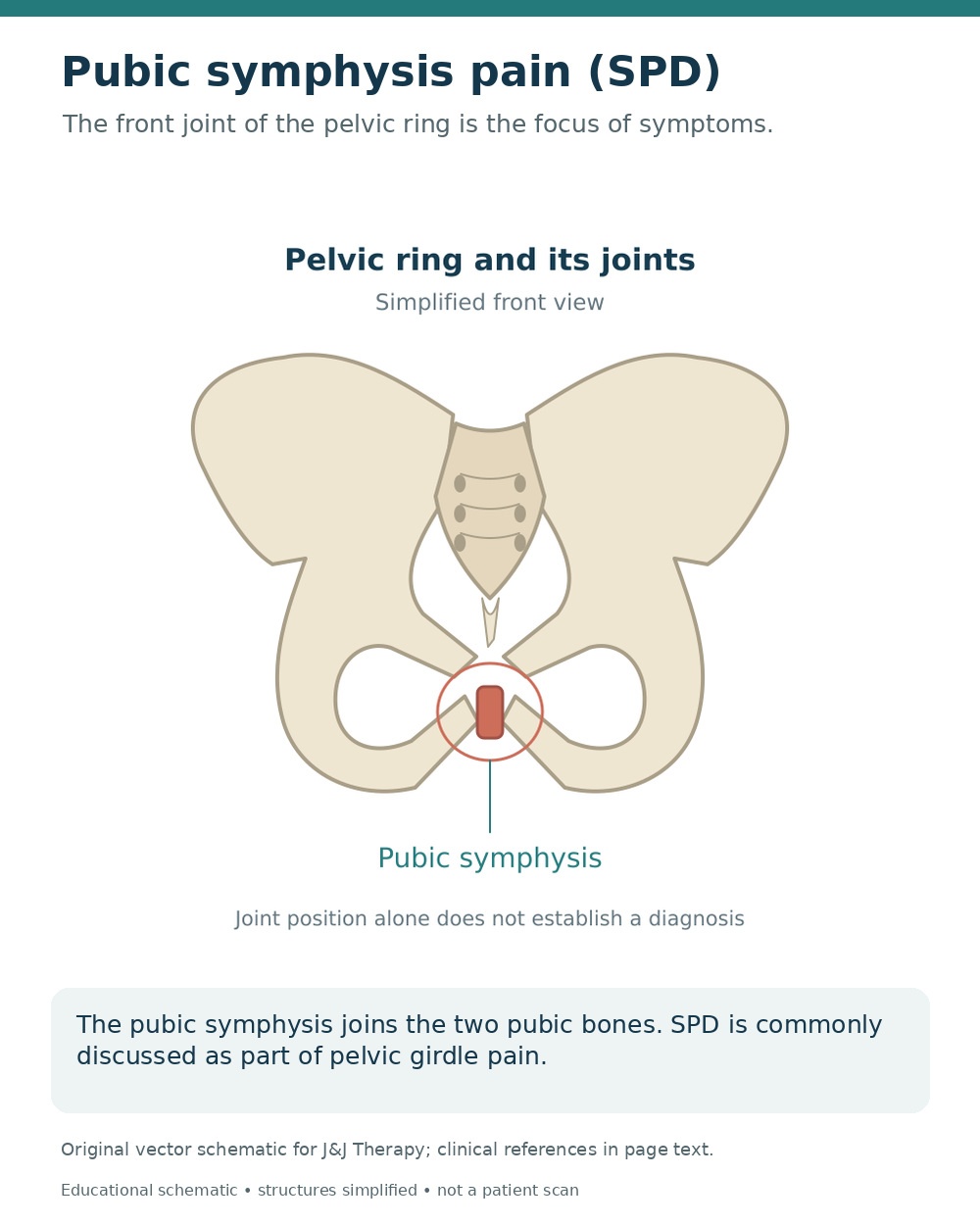
SPD describes pain arising from the pubic symphysis — the joint at the front of your pelvis where the two pubic bones meet. It sits within the broader diagnosis now known as Pregnancy-Related Pelvic Girdle Pain (PGP), which covers pain at the pubic symphysis at the front and the sacroiliac joints at the back of the pelvis (Vleeming et al., European Spine Journal, 2008). UK bodies now favour the term PGP, and the Royal College of Obstetricians and Gynaecologists notes that PGP was previously known as symphysis pubis dysfunction.
Why it happens
During pregnancy your body produces hormones, including relaxin, that increase the natural give in your pelvic ligaments to prepare for birth. It is a common myth that hormone levels alone cause the pain — a systematic review found only low-level evidence linking circulating relaxin levels with pelvic girdle pain (Aldabe et al., European Spine Journal, 2012). Current understanding is that SPD is multifactorial, combining altered load transfer through the pelvic ring, changes in muscle control and coordination, and individual biomechanical factors.
What is happening to the joint
A small increase in the gap at the pubic symphysis is entirely normal during pregnancy. A separation beyond 10 mm is termed pubic symphysis diastasis, which is a distinct and much rarer condition. Ordinary SPD is a pain and function problem — it does not mean your pelvis is coming apart, and it will not harm your baby.
How common is it, and will it settle?
PGP affects approximately 1 in 5 pregnant women. Symptoms can begin in any trimester, but typically start around the 18th week and peak between weeks 24 and 36. The outlook is reassuring: most women improve considerably after birth, although research suggests about a third have some symptoms at three months postpartum, so continuing physiotherapy is worthwhile if your pain has not settled.
Do You Experience These Symptoms?
✓ Pain over the pubic bone at the front of your pelvis — often the main symptom
✓ Pain spreading into your groin, inner thighs or the area between your legs
✓ A clicking, grinding or giving-way sensation in the pelvic area — this is not a sign of damage
✓ Difficulty with single-leg activities such as climbing stairs, getting dressed, or getting in and out of a car
✓ Pain when turning over or rolling in bed, with disturbed sleep
✓ A rolling or waddling way of walking, especially over longer distances
✓ Pain on standing or taking weight after you have been sitting or resting
These symptoms can be treated.
The sooner you begin, the better your chances of a smoother recovery.
What Causes SPD?
• Hormonal ligamentous laxity in pregnancy
Pregnancy hormones increase the natural give in the ligaments that support your pelvic joints, which can reduce pelvic stability.
This laxity is a normal and necessary adaptation for birth, and on its own does not reliably predict who will develop pain.
• Increased load and altered biomechanics
As your baby grows, the extra weight and your shifting centre of gravity change how force is transferred through the pelvic ring.
These altered loads can outstrip your pelvis’s ability to stay stable and comfortable, particularly later in pregnancy.
• Previous pelvic girdle or low back pain
A history of low back pain or previous pelvic girdle pain is one of the most consistent risk factors for developing SPD.
Earlier pelvic injury or trauma can also leave the joints more vulnerable to pain during pregnancy.
• Muscle control deficits in the deep stabilising system
Your pelvis relies on well-timed activity of the deep stabilising muscles — the transversus abdominis, pelvic floor and gluteals — to control load.
When this coordination is altered, the pubic symphysis is less well supported, which can contribute to pain.
• Previous pregnancies and asymmetric loading
Previous pregnancies, a higher body mass index and strenuous or one-sided activities are associated with a greater likelihood of pelvic girdle pain.
Repeated lifting, prolonged standing or carrying a toddler on one hip places uneven strain across the pelvis and can aggravate symptoms.
How We Treat SPD at J&J Therapy
Hands-On Manual Therapy
Gentle, hands-on treatment tailored to SPD and fully adapted for pregnancy — including mobilisation of the lumbar spine, hips and pelvic joints, and soft tissue work for the adductors, hip flexors and gluteals to offload the pubic symphysis.
We also fit and advise on a non-rigid pelvic support belt where appropriate, and we never use forceful manipulation of the pubic symphysis.
Shockwave Therapy*
Because SPD is a pregnancy-related condition, shockwave therapy is not suitable here — pregnancy is a recognised contraindication for this treatment.
For conditions arising during pregnancy, our care emphasises specialised manual therapy and targeted exercises — the safest and most appropriate approach for your specific needs.
Targeted Exercise Programme
An individualised, pregnancy-safe programme covering pelvic floor training, deep core activation, and gluteal and hip stability work to share load more evenly across your pelvis.
We include practical load management, movement strategies to avoid aggravating positions, and a clear postnatal progression to rebuild strength after birth.
When to Seek Urgent Medical Help
While most symptoms are not serious, urgent medical attention is required if you experience any of the following:
Signs of preterm labour — regular tightenings or cramping, low back pain coming in waves, pelvic pressure, vaginal bleeding, or a gush or trickle of fluid. Contact your maternity unit immediately.
Sudden, severe pubic pain and an inability to bear weight, which may need prompt obstetric assessment.
A fever alongside pelvic pain, or feeling generally unwell — contact your GP, midwife or NHS 111 urgently.
New bladder or bowel problems, numbness between your inner thighs, or weakness in both legs — go to A&E immediately.
A noticeable reduction in your baby’s movements — contact your maternity triage straight away.
FAQs About SPD
Will my SPD go away after I have my baby?
For most women, yes. Symptoms usually improve significantly after birth, and the majority settle within the first few weeks. Research on prognosis suggests around a third of women still have some symptoms at three months postpartum, so if your pain has not settled a couple of weeks after birth it is worth continuing physiotherapy rather than waiting it out.
Is it safe to exercise and stay active with SPD?
Yes — staying active within comfortable limits is encouraged, and the right exercises are one of the most effective treatments available (Liddle & Pennick, Cochrane Database of Systematic Reviews, 2015). The key is to avoid movements that aggravate your pain, such as wide-legged or heavily one-sided activities, and to pace yourself. Our physiotherapists will give you a personalised programme so you know exactly what is safe for you.
Will SPD affect how I give birth?
Usually not. Most women with SPD can have a normal vaginal birth, and a caesarean is not normally needed for SPD — there is no evidence it helps, and it may slow your recovery. It helps to tell your midwife and birth team that you have SPD so they can support your legs, help you change position, and note a comfortable range for moving your knees apart during labour.
Do you use shockwave therapy for SPD?
No. Shockwave therapy is not suitable for pregnancy-related SPD. Pregnancy is a listed contraindication in both the international shockwave guidelines and our device manufacturer’s instructions for use, because treatment must not be directed near a developing baby.
For SPD, the safest and most effective care is hands-on manual therapy combined with a targeted, pregnancy-safe exercise programme — which is exactly what we provide. If pelvic pain persists after your baby is born, we can reassess all of your options at that stage.
How many sessions will I need, and can a support belt help?
Everyone is different, but many people notice improvement within a few sessions, and we usually plan an initial assessment followed by a small number of reviews across your pregnancy. A non-rigid pelvic support belt can be a helpful addition — NICE supports considering one, and we can assess whether it suits you and show you how to fit and use it correctly.
This page is for general information only and does not replace professional medical advice.
Reviewed by Lavya Arigalayan, MSc, HCPC Registered Physiotherapist.
Last reviewed:
2026년 8월 20일