top of page
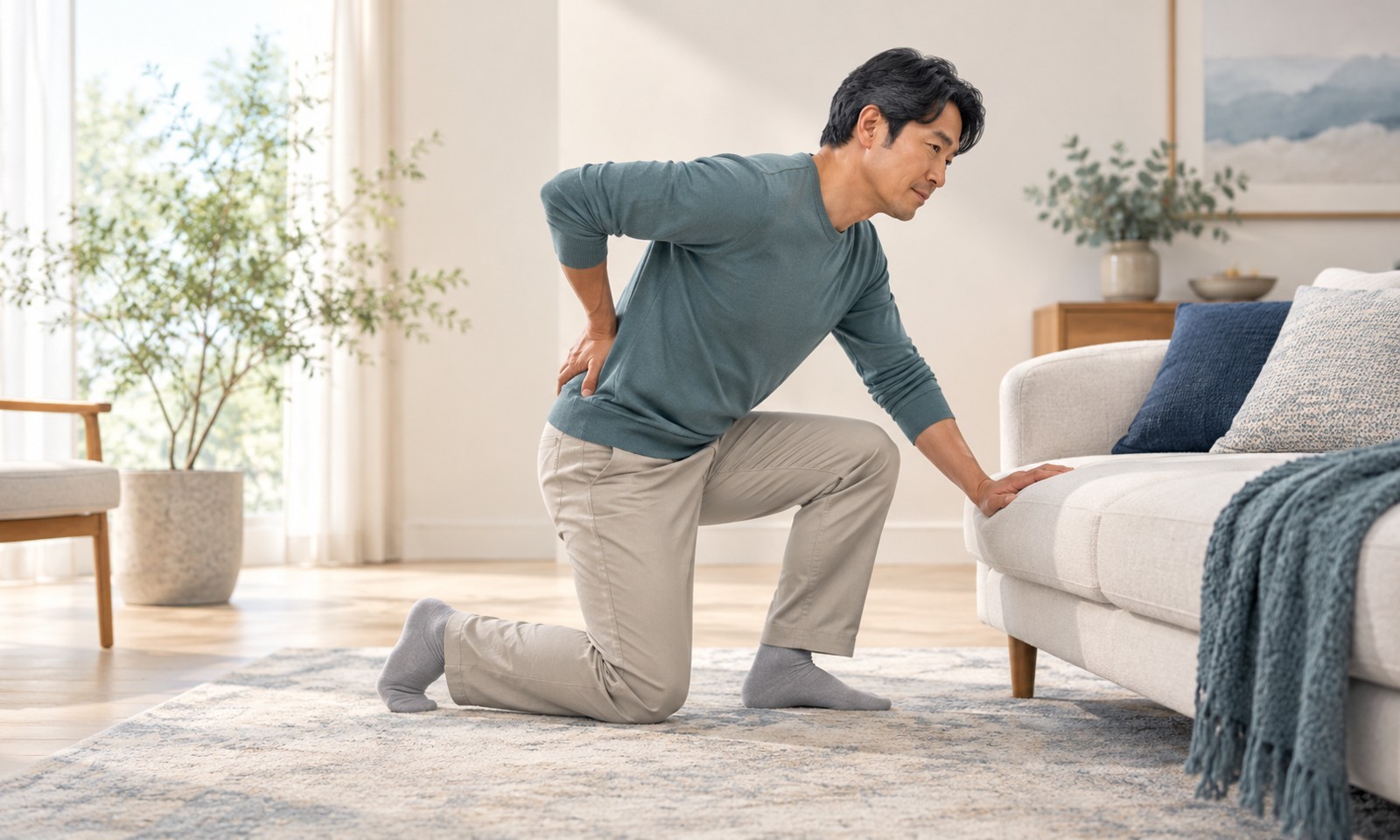
Physiotherapist assessing a patient's lower back for slipped disc pain at J&J Therapy in New Malden

Slipped Disc / Herniated Disc

300+ Reviews 5.0

Open 7 Days

10+ Years' Experience

HCPC Physio On Team

Insurance Accepted

85% Return Rate

PHYSIOTHERAPY & THERAPEUTIC MASSAGE IN NEW MALDEN

Quick Summary

A slipped disc — known medically as a herniated or prolapsed intervertebral disc — occurs when the soft inner core of a spinal disc pushes through its tougher outer wall and presses on or inflames a nearby nerve root, causing lower back pain and often radiating leg pain (sciatica). The natural history is generally favourable: research shows that most herniated discs shrink on their own over time, and the majority of people improve with conservative, physiotherapy-led care. At J&J Therapy we typically recommend an initial course of 6–8 sessions over 6–8 weeks, with reassessment at every stage.

What Is a Slipped Disc?

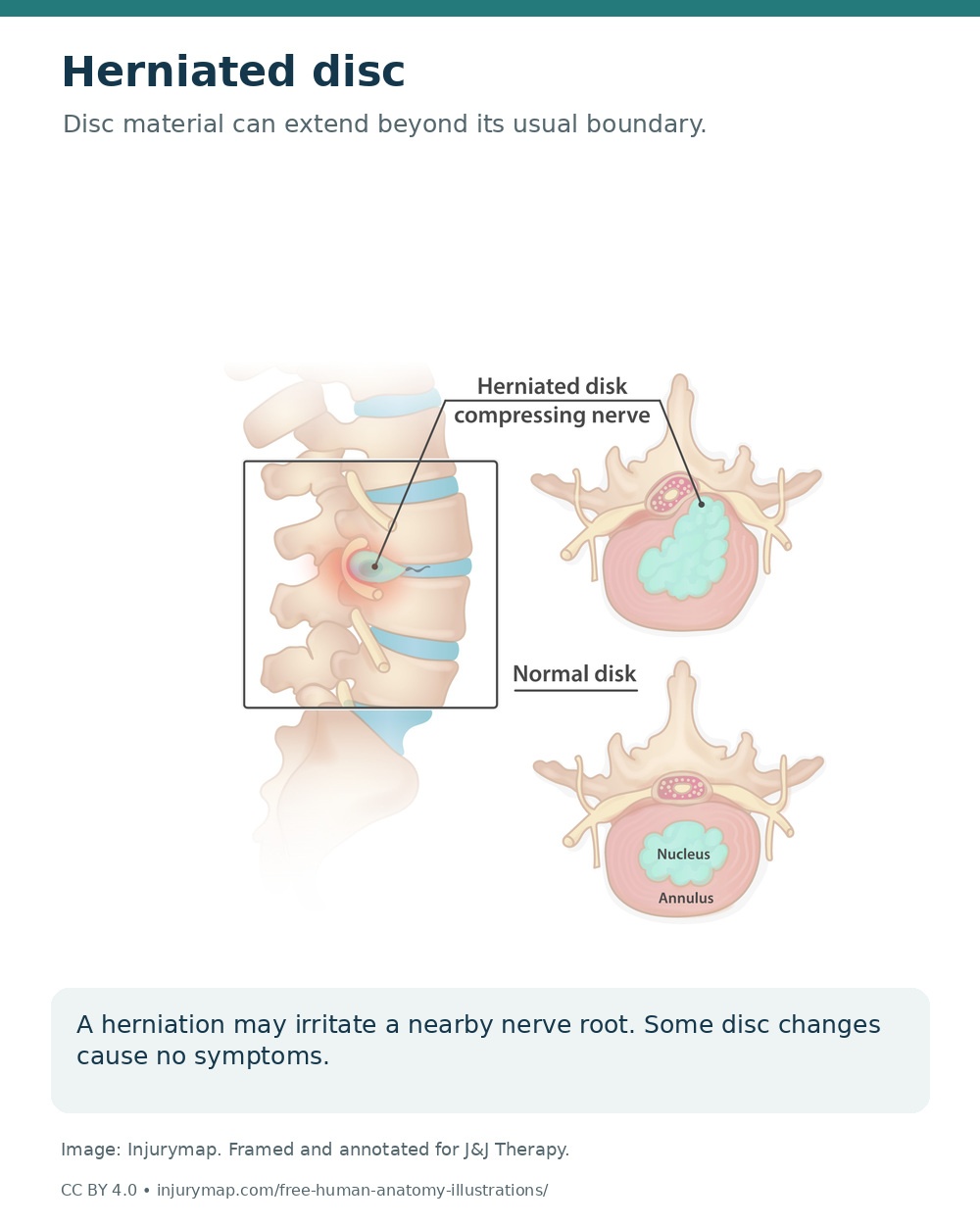
Diagram of a lumbar herniated disc pressing on a spinal nerve root causing sciatica

Each intervertebral disc has a gel-like centre (the nucleus pulposus) enclosed by a tough fibrous ring (the annulus fibrosus). The term "slipped disc" is a misnomer — the disc does not slip out of place. Instead, the outer ring weakens or tears and inner disc material displaces backwards towards the spinal nerves. Around 95% of lumbar disc herniations occur at the L4–L5 or L5–S1 levels.


Pain arises through two mechanisms working together: direct mechanical pressure on the nerve root, and a chemical inflammatory reaction as displaced disc material provokes irritation around the nerve. This is why leg pain can be severe even when the herniation itself is relatively small.


Disc changes are graded along a spectrum of increasing severity:


Bulge: The disc wall extends beyond its normal border without a focal tear.

Protrusion: Inner material pushes into a weakened area of the outer ring.

Extrusion: Material breaches the outer ring but remains connected to the parent disc.

Sequestration: A fragment separates entirely from the disc.


Importantly, disc changes are common on scans in people with no pain at all — the prevalence of disc protrusion in pain-free individuals rises from around 29% at age 20 to 43% at age 80 (Brinjikji et al., American Journal of Neuroradiology, 2015). This is why a slipped disc is never diagnosed from a scan alone; your symptoms and clinical examination must match the imaging.


The outlook is more reassuring than many people expect. A systematic review and meta-analysis found an overall spontaneous resorption rate of 66.66% — and, perhaps surprisingly, larger extruded herniations were the most likely to resorb, because exposure to the local blood supply triggers a natural clearance response (Zhong et al., Pain Physician, 2017). Evidence suggests that up to 80% of people with sciatica recover within around 8 weeks. UK guidance therefore recommends conservative care first, with exercise at the centre of treatment and manual therapy as part of that package (NICE NG59, 2016, updated 2020).

Do You Experience These Symptoms?

✓  Lower back pain that may be accompanied by — or overshadowed by — pain travelling down the leg

✓  Radiating pain through the buttock, thigh, calf or foot following a nerve pathway, commonly called sciatica

✓  Pins and needles, tingling or numbness in the leg or foot

✓  Leg pain that worsens with sitting, bending forwards, coughing or sneezing

✓  Muscle weakness in the affected leg — for example difficulty lifting your foot or standing on tiptoe

✓  Symptoms usually felt on one side of the body only

✓  Pain often eased by standing or gentle walking and aggravated by prolonged sitting or driving

These symptoms can be treated.
The sooner you begin, the better your chances of a smoother recovery.

What Causes a Slipped Disc?

•  Age-related disc degeneration

With age the discs lose water content and elasticity, making the outer ring more prone to tearing under load.

This is why symptomatic herniations peak between the ages of about 30 and 50, when the discs still contain enough gel-like material to displace.


•  Sudden loading or awkward lifting

Bending and lifting a heavy object, particularly while twisting, can raise pressure inside the disc sharply and force material through a weakened wall.

Many patients recall a specific bending, lifting or twisting moment at the point their symptoms began.


•  Repetitive strain and sustained postures

Prolonged sitting, long-distance driving and repeated forward bending increase the load on your lumbar discs over time.

Occupations involving heavy manual handling or whole-body vibration carry a recognised higher risk.


•  Lifestyle and general health factors

Smoking, excess body weight and low physical fitness are established risk factors, partly through reduced disc nutrition and increased mechanical load.

A family tendency towards disc degeneration also contributes in some people.


Not sure which condition applies to you?

How We Treat Slipped Discs at J&J Therapy

Hands-On Manual Therapy

Spinal mobilisation, soft-tissue release and neural mobilisation ("nerve gliding") techniques to ease pain, reduce protective muscle guarding and restore comfortable movement — always delivered alongside your active exercise programme, as NICE advises.

Shockwave Therapy*

Swiss Storz Medical MASTERPULS
is never directed at the disc, spine or nerve itself. Where your assessment identifies persistent tension in the surrounding paraspinal, quadratus lumborum or gluteal muscles, it may complement your manual therapy and exercise programme.
Non-invasive, evidence-based. Always used as an adjunct, never as a stand-alone treatment.

Targeted Exercise Programme

A progressive, individualised programme combining directional-preference movements, core and trunk stabilisation, hip and gluteal strengthening, and a graded return to normal activity — the intervention NICE places at the centre of recovery and long-term self-management.

When to Seek Urgent Medical Help

While most symptoms are not serious, urgent medical attention is required if you experience any of the following:

  • New difficulty passing urine, loss of bladder or bowel control, or numbness around the saddle area (genitals, buttocks, inner thighs) — go straight to A&E, as this may indicate cauda equina syndrome

  • Progressive or severe leg weakness, such as a worsening foot drop or difficulty lifting your foot

  • Rapidly worsening sciatica, or symptoms affecting both legs

  • Back pain with fever, unexplained weight loss, a history of cancer, or following significant trauma

FAQs About Slipped Disc

  • Will my slipped disc heal without surgery?

In most cases, yes. Sciatica from a herniated disc is largely self-limiting, and research shows the majority of herniated discs shrink over time through a natural resorption process (Zhong et al., Pain Physician, 2017). Most people improve substantially within weeks to a few months with conservative, physiotherapy-led care, and surgical referral is generally reserved for persistent, disabling or progressive cases (NICE NG59, 2016, updated 2020).


  • How long does recovery usually take?

Many people notice meaningful improvement within about six weeks, and evidence suggests up to 80% of people with sciatica recover within around eight weeks. Recovery varies with the size and level of the herniation and your general health, which is why we reassess your progress regularly and adjust your programme accordingly.


  • Should I rest or stay active?

Staying gently active is strongly recommended — prolonged bed rest can slow your recovery. Our physiotherapists help you keep moving within comfortable limits and gradually rebuild strength, which both the research evidence and NICE guidance support as central to recovery.


  • Is it safe to have hands-on treatment for a slipped disc?

Manual therapy — including spinal mobilisation and soft-tissue work — may help ease pain and stiffness, and NICE supports it as part of a treatment package that includes exercise. Our physiotherapists assess you thoroughly first and tailor hands-on techniques to your presentation, avoiding anything unsuitable for your symptoms.


  • Can shockwave therapy treat my slipped disc?

Shockwave therapy does not treat the disc herniation itself, and we never apply it to the spine, disc or nerve. Where a slipped disc is accompanied by persistent muscular pain and tension in the surrounding soft tissues — such as the lumbar paraspinal, quadratus lumborum or gluteal muscles — we may, only after assessment, use our Swiss Storz Medical MASTERPULS radial shockwave device on those muscles as an adjunct to your manual therapy and exercise programme. Early research suggests this may improve pain and function when added to conventional physiotherapy, though the evidence base remains limited, so it is always part of a wider plan rather than a stand-alone treatment.

Not sure this condition matches your symtoms?
Find your condition and explore related pain areas.

Logo_Navy.png

Ready to start your recovery?
Book your Initial Assessment today.

This page is for general information only and does not replace professional medical advice.

Reviewed by Lavya Arigalayan, MSc, HCPC Registered Physiotherapist.

Last reviewed

2026년 8월 20일

bottom of page