top of page
Physiotherapist assessing a patient's shoulder stability at J&J Therapy in New Malden

Shoulder Instability / Dislocation Rehab

300+ Reviews 5.0

Open 7 Days

10+ Years' Experience

HCPC Physio On Team

Insurance Accepted

85% Return Rate

PHYSIOTHERAPY & THERAPEUTIC MASSAGE IN NEW MALDEN

Quick Summary

If your shoulder feels like it might slip or pop out — often after a previous dislocation — structured, exercise-based rehabilitation is the evidence-backed first-line approach, and research shows most people recover well without surgery.

Our HCPC-registered physiotherapists combine hands-on manual therapy with a progressive, individualised exercise programme to rebuild rotator cuff and scapular control, restore proprioception and give you back confidence in the joint.

Recovery typically takes around 12 weeks for everyday activities, with a return to contact or overhead sport often taking longer.

What Is Shoulder Instability?

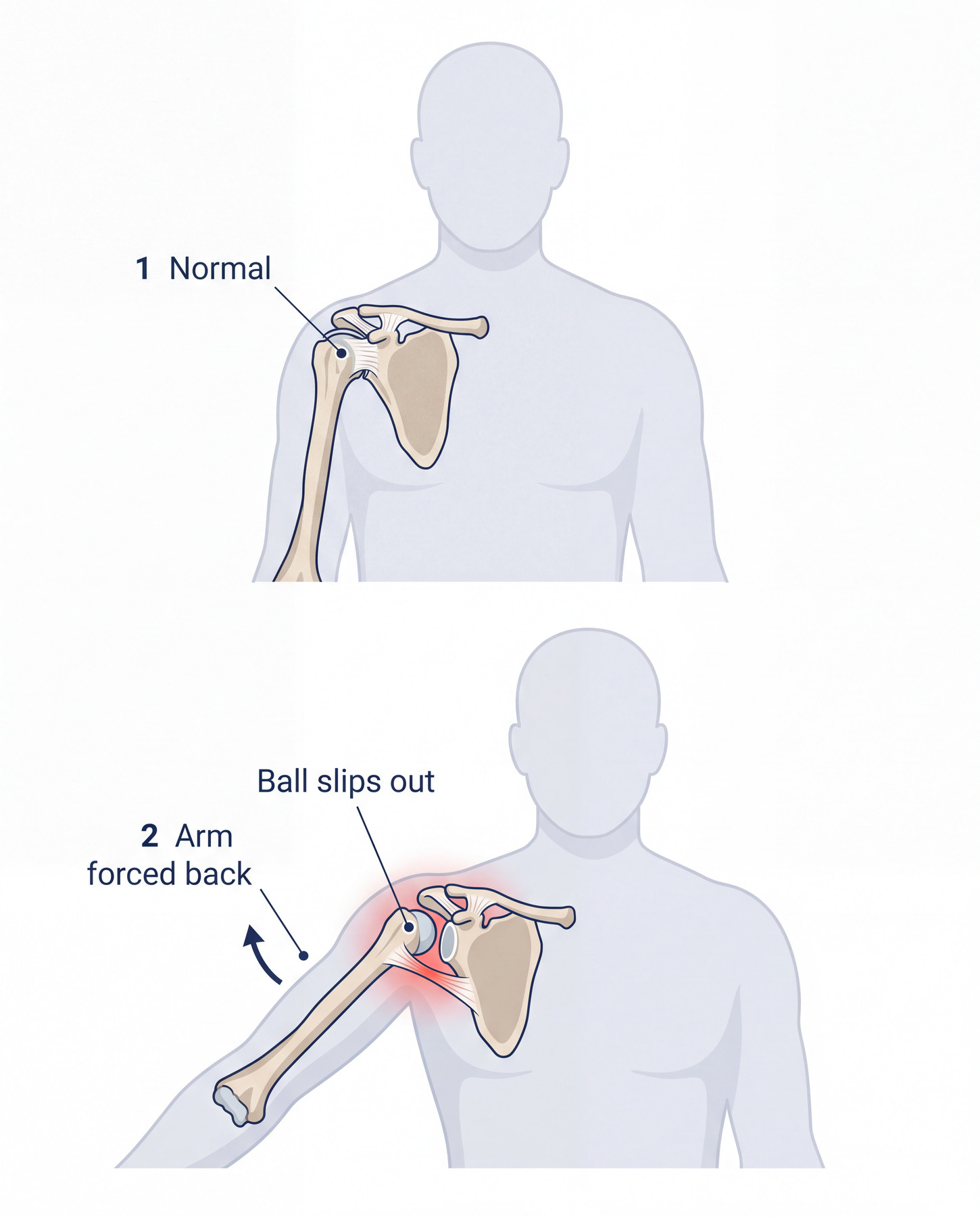
Diagram of the glenohumeral joint showing the humeral head and glenoid socket relevant to shoulder instability

Shoulder instability is the abnormal or excessive movement of the ball (humeral head) within the shallow socket (glenoid) of your shoulder joint, causing pain, a sense of the joint slipping, partial displacement (subluxation) or full dislocation. The shoulder is the most mobile joint in the body — and the most commonly dislocated, with around 96% of dislocations occurring in the anterior (forward) direction.


Clinicians understand instability as a spectrum rather than a single condition. The Stanmore classification describes three overlapping patterns: traumatic structural instability (typically after a dislocation, often with a tear of the labrum known as a Bankart lesion), atraumatic structural instability (linked to naturally lax joint tissues), and muscle-patterning instability (where the muscles around the shoulder fire in an unbalanced sequence).


Research shows that structural damage is common even after a first dislocation — a systematic review of 1,920 shoulders found labral (Bankart) lesions in 59% and humeral head impaction (Hill-Sachs) lesions in 71% of first-time dislocations (Hurley et al., Archives of Orthopaedic and Trauma Surgery, 2022).


The large UK ARTISAN randomised controlled trial (Kearney et al., BMJ, 2024) found that most adults managed without surgery after a first traumatic dislocation do well, supporting exercise-based rehabilitation as the sensible starting point for the majority of people.

Do You Experience These Symptoms?

✓  A feeling that your shoulder might pop out or give way, especially with your arm raised and rotated outwards

✓  One or more previous dislocations or partial slips (subluxations)

✓  Apprehension or fear when placing your arm in certain positions, such as reaching overhead or behind you

✓  Pain, aching or clicking around the shoulder, particularly after activity

✓  A sense of looseness, weakness or your arm feeling heavy

✓  Reduced confidence in your shoulder during sport, lifting or overhead tasks

✓  Numbness, tingling or a dead-arm sensation around the time of a slip

These symptoms can be treated.
The sooner you begin, the better your chances of a smoother recovery.

What Causes Shoulder Instability?

•  Traumatic dislocation

A significant force — commonly a fall onto an outstretched arm or a sporting collision — pushes the ball of the joint out of its socket. This frequently tears the labrum or stretches the joint capsule, leaving the shoulder prone to repeat episodes.


•  Repetitive overload and overhead demand

Sports such as swimming, throwing, racquet sports and volleyball place large, repeated demands on the shoulder. Over time this can stretch the stabilising soft tissues and disturb the fine coordination that keeps the joint centred.


•  Joint hypermobility and capsular laxity

Some people have naturally lax connective tissue, sometimes as part of generalised hypermobility. This can allow the ball to translate excessively in several directions, producing atraumatic multidirectional instability.


•  Altered muscle control (muscle patterning)

In some cases the muscles around the shoulder fire in an unbalanced sequence, pulling the joint off-centre. This neuromuscular pattern can occur with or without a structural injury and responds well to targeted retraining.


•  Previous dislocation at a young age

Age at first dislocation strongly influences recurrence risk, which research suggests is highest in teenagers and young adults. Structured rehabilitation aims to reduce this risk by rebuilding strength, control and confidence.

Not sure which condition applies to you?

How We Treat Shoulder Instability at J&J Therapy

Hands-On Manual Therapy

Our physiotherapists use hands-on manual therapy — including joint mobilisations, soft-tissue techniques and guided movement re-education — to settle pain, restore comfortable range of movement and prepare your shoulder for active rehabilitation. We first assess the direction and type of your instability, then tailor any hands-on work to support the exercise programme that drives lasting stability.

Shockwave Therapy*

Shockwave therapy is not a treatment for shoulder instability itself. However, if your assessment identifies a coexisting rotator cuff tendinopathy contributing to your symptoms, our Swiss Storz Medical MASTERPULS may complement your manual therapy and exercise programme when your physiotherapist identifies specific indications during assessment. Non-invasive; evidence in this setting is limited and supportive at best.

Targeted Exercise Programme

Structured, progressive exercise is the cornerstone of instability rehabilitation. Your programme is staged: early activation of the rotator cuff and shoulder blade muscles within safe ranges, progressive strengthening and retraining of muscle firing patterns, proprioception and reactive control drills, and finally sport-specific or functional tasks. We draw on established frameworks such as the Derby Shoulder Instability Programme and the Watson multidirectional instability programme, with progression guided by restored strength, movement and confidence rather than time alone.

When to Seek Urgent Medical Help

While most symptoms are not serious, urgent medical attention is required if you experience any of the following:

  • A shoulder that is dislocated and has not gone back in — an obviously deformed shoulder with loss of movement after trauma, a seizure or an electric shock needs same-day emergency assessment. Do not attempt to force it back yourself.

  • Signs of nerve or blood-vessel injury — numbness over the outer shoulder, a weak or dead arm, or a cold, pale hand requires urgent medical care.

  • A first-time dislocation or suspected fracture-dislocation — this should be assessed in A&E, with imaging to exclude a fracture, before rehabilitation begins.

  • Frequent re-dislocations or instability with suspected significant bone loss — this warrants a specialist orthopaedic opinion, which we can help arrange.

FAQs About Shoulder Instability

  • Will I need surgery for shoulder instability?

For most people — especially those with atraumatic or multidirectional instability — structured physiotherapy is the recommended first-line treatment. However, in young, active people who sustain a traumatic dislocation with structural damage, the risk of recurrence is high, and evidence shows early surgical stabilisation can substantially reduce re-dislocation in this group. We will help you understand your individual risk and, where appropriate, support a shared decision with a shoulder surgeon.


  • How likely is my shoulder to dislocate again?

It depends heavily on your age and activity level. Research suggests recurrence affects roughly three quarters of teenagers after a traumatic dislocation, around half of those in their twenties, and only a small minority of older adults. Good rehabilitation aims to reduce that risk by rebuilding strength, control and confidence.


  • How long will rehabilitation take?

Recovery from a straightforward dislocation typically takes around 12 weeks for everyday activities, with a return to contact or overhead sport often taking 16 weeks or longer. Atraumatic and multidirectional instability programmes commonly run over several months, reflecting the time needed to retrain muscle control.


  • Can shockwave therapy fix my unstable shoulder?

No — shockwave therapy is not a treatment for instability itself, and the evidence does not support using it for that purpose. Its only possible role would be as a complement to your rehabilitation if your assessment identifies a coexisting rotator cuff tendinopathy, and even then the evidence is limited. Your core treatment will always be manual therapy and a structured exercise programme.

Not sure this condition matches your symtoms?
Find your condition and explore related pain areas.

Logo_Navy.png

Ready to start your recovery?
Book your Initial Assessment today.

This page is for general information only and does not replace professional medical advice.

Reviewed by Lavya Arigalayan, MSc, HCPC Registered Physiotherapist.

Last reviewed

2026년 8월 20일

bottom of page