top of page
Physiotherapist examining the swollen front of a patient's kneecap during a prepatellar bursitis assessment at a New Malden clinic

Prepatellar Bursitis

300+ Reviews 5.0

Open 7 Days

10+ Years' Experience

HCPC Physio On Team

Insurance Accepted

85% Return Rate

PHYSIOTHERAPY & THERAPEUTIC MASSAGE IN NEW MALDEN

Quick Summary

Prepatellar bursitis — commonly known as housemaid's knee — is inflammation of the small fluid-filled sac that sits between your kneecap and the overlying skin. It usually develops after prolonged or repeated kneeling, or following a direct blow to the front of the knee.


Most non-infected cases settle within a few weeks with activity modification, load management and a guided exercise programme. Our physiotherapists typically plan an initial course of around 4–6 sessions, reviewing your progress as your symptoms improve.


Because this bursa lies just beneath the skin, we always screen carefully for signs of infection at your first appointment, as infected (septic) bursitis needs urgent medical treatment rather than physiotherapy.

What Is Prepatellar Bursitis?

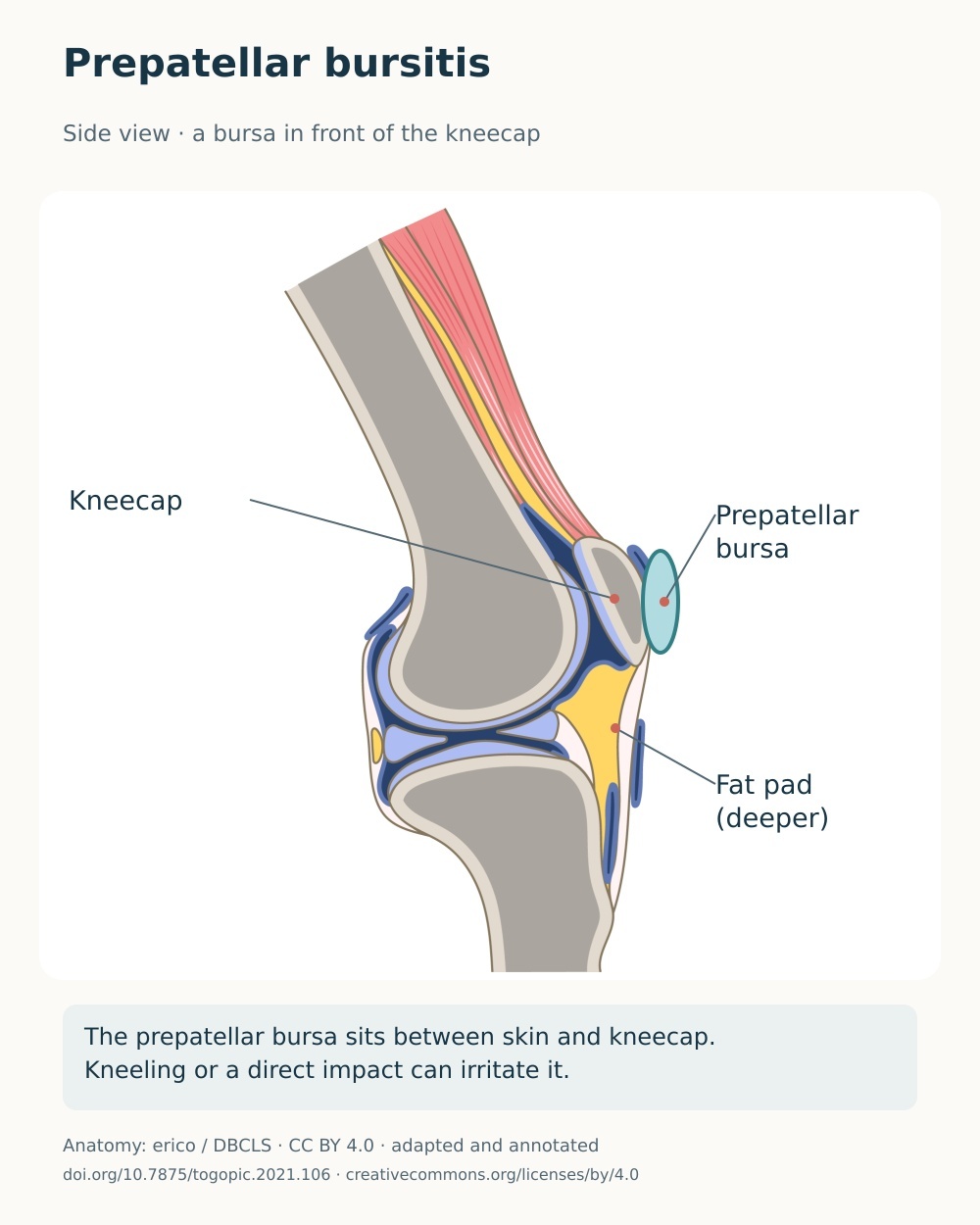
Anatomical illustration of the prepatellar bursa between the kneecap and skin, shown in normal and inflamed states

A bursa is a thin, synovial-lined sac that reduces friction between moving structures such as skin, tendon and bone. The prepatellar bursa lies superficially between the skin and the front of your patella (kneecap) and normally contains only a minimal amount of fluid. When it becomes irritated, the lining produces excess fluid and the bursa swells noticeably at the front of the knee — the hallmark of prepatellar bursitis.


The most commonly affected bursa of the knee

The prepatellar bursa is the most commonly affected bursa of the knee and the second most commonly affected superficial bursa in the body after the olecranon bursa at the elbow. Research suggests a minimum annual incidence of around 10 per 100,000 people, with roughly 80% of patients being men aged between 40 and 60 — a pattern that reflects its strong occupational association.

(Baumbach et al., Archives of Orthopaedic and Trauma Surgery, 2014)


Acute and chronic presentations

Acute prepatellar bursitis tends to follow a single injury, such as a fall or direct blow, and comes on quickly with swelling and pain. Chronic prepatellar bursitis develops gradually from repeated pressure and microtrauma, most often from occupational kneeling, and frequently presents as swelling over the kneecap with little or no pain.

(Khodaee, American Family Physician, 2017)


Why we screen for infection first

This is the single most important distinction in prepatellar bursitis. Evidence shows that approximately one third of prepatellar and olecranon bursitis cases are septic, meaning infected, while two thirds are non-septic. Because the bursa is so superficial, bacteria can enter through even a minor break in the overlying skin. Clinical features alone cannot reliably exclude infection, so if we suspect it we will refer you promptly for medical assessment before any hands-on or device-based treatment begins.

(Lormeau et al., Joint Bone Spine, 2019)

Do You Experience These Symptoms?

✓  Swelling at the front of your kneecap — often a well-defined, fluid-filled lump that may appear suddenly or build up gradually

✓  Tenderness and pain over the front of the knee, particularly when kneeling or applying direct pressure

✓  A feeling of fullness or tightness across the front of the knee

✓  Discomfort when bending the knee fully, although your overall range of movement is often well preserved

✓  Mild warmth and reddening of the skin over the swelling

✓  Pain that worsens with kneeling, crawling, squatting or prolonged time on hard surfaces

✓  Rapidly increasing pain, hot skin, fever or feeling generally unwell — these suggest infection and need urgent medical attention

These symptoms can be treated.
The sooner you begin, the better your chances of a smoother recovery.

What Causes Prepatellar Bursitis?

•  Prolonged or repetitive kneeling at work

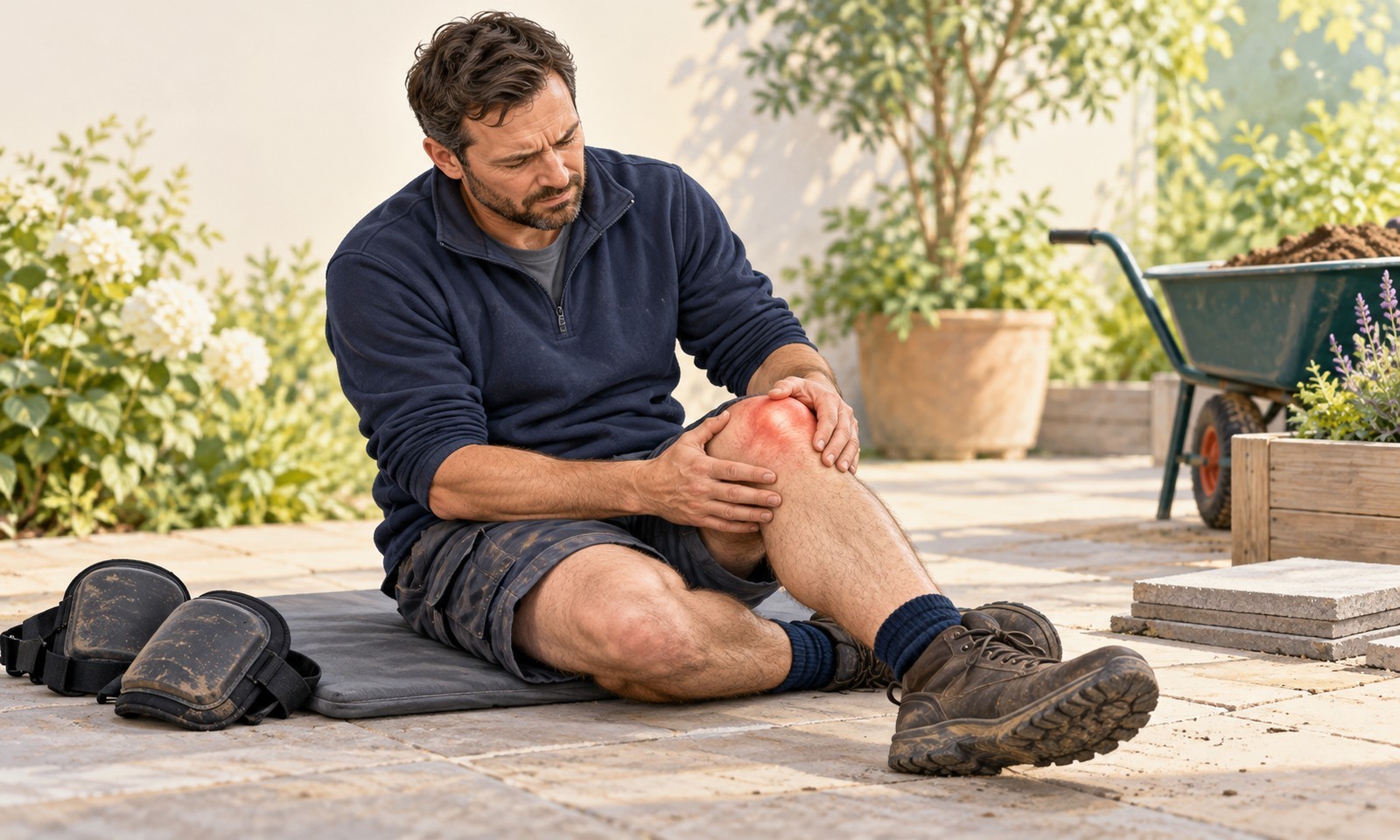
This is the classic cause, and the reason for the traditional names housemaid's knee and carpet layer's knee. Sustained pressure on the front of the knee causes repeated microtrauma to the bursa, and UK trades at particular risk include carpet and flooring fitters, tilers, plumbers, roofers, gardeners, cleaners and construction workers.


•  Direct trauma to the kneecap

A fall directly onto the knee or a single hard blow can trigger an acute, sometimes blood-filled swelling of the bursa. This is common in contact and court sports, as well as in slips and falls at work or at home.


•  Infection entering through the skin

Because the bursa sits just beneath the skin, bacteria can enter through cuts, grazes or insect bites over the kneecap and produce septic bursitis. Risk is higher if you have diabetes, a weakened immune system, or a recent break in the skin over your knee.


•  Underlying inflammatory or crystal conditions

Gout, pseudogout and rheumatoid arthritis can all inflame the prepatellar bursa. In these cases the bursitis is one feature of a wider condition, so management addresses the underlying disease alongside the local swelling.


•  Returning to kneeling before the bursa has settled

Many recurrences happen because the original kneeling load resumes too soon after symptoms ease. Without changes to knee protection, technique or task rotation, the same irritation simply builds up again.

Not sure which condition applies to you?

How We Treat Prepatellar Bursitis at J&J Therapy

Hands-On Manual Therapy

Our physiotherapists begin with a thorough assessment to confirm the diagnosis and, crucially, to screen for signs of infection before any hands-on treatment. For non-infected prepatellar bursitis, the mainstay of early care is conservative: relative rest, activity modification, ice and protection of the bursa. We use gentle soft-tissue work and mobilisation of the surrounding quadriceps, hamstring and calf structures to relieve tension around the knee, alongside practical advice on swelling control and load management. We do not aspirate or inject the bursa, as these are medical procedures, but we will explain the evidence around them and arrange onward GP or specialist referral where appropriate.

Shockwave Therapy*

For most people with housemaid's knee, shockwave therapy is not needed — the condition usually settles with activity modification, load management and a targeted exercise programme. In selected chronic or persistent cases that have not responded to first-line care, our Swiss Storz Medical MASTERPULS radial shockwave device may complement your manual therapy and exercise programme when your physiotherapist identifies specific indications during assessment, and only once infection has been ruled out. We are honest about the evidence: there are currently no high-quality trials of shockwave therapy specifically for prepatellar bursitis, so where we use it we do so cautiously, as a non-invasive adjunct alongside — not instead of — proven conservative care.

Targeted Exercise Programme

Once pain and swelling begin to settle, we guide you through a progressive, individualised exercise programme. Early work focuses on pain-free range of movement and gentle quadriceps activation to stop the thigh muscles de-conditioning while you rest the knee. As you improve, we add stretching for the quadriceps, hamstrings and calf, progressive strengthening of the quadriceps and hip, and balance work to restore confident, controlled movement. The programme is always paired with practical kneeling-avoidance strategies — including properly cushioned knee pads, task rotation and technique changes — because addressing the underlying kneeling load is the most important factor in preventing the problem returning.

When to Seek Urgent Medical Help

While most symptoms are not serious, urgent medical attention is required if you experience any of the following:

  • Spreading redness, heat and increasing swelling over and around your kneecap, particularly if the redness extends beyond the swelling itself

  • Fever, chills, sweats or feeling generally unwell alongside a swollen, painful knee

  • Rapidly worsening or severe pain, especially if the skin is hot and taut or there is a cut, graze or wound over the swelling

  • Swelling that does not improve with rest or keeps returning, and any knee swelling if you have diabetes or a weakened immune system

These may indicate an infected bursa, which needs prompt medical assessment and antibiotic treatment. Please contact your GP, NHS 111 or an urgent care centre the same day.

FAQs About Prepatellar Bursitis

  • How long does housemaid's knee take to get better?

Most non-infected cases settle within a few weeks, commonly around two to six, provided you rest the knee, control the swelling and modify the activity that caused it. Chronic cases, or those in people who must keep kneeling for work, can take longer and are more likely to return — which is why load management and a proper exercise programme matter so much.


  • Do I need my knee drained or injected?

Usually not. For most non-infected cases, conservative care is the mainstay. Aspiration, meaning drawing off fluid, is used mainly to test for infection. Corticosteroid injection into this particular bursa is generally avoided because it sits so close to the skin, carrying a recognised risk of skin thinning, skin discolouration and introducing infection. Any decision about aspiration or injection is a medical one made by your GP or a specialist, and we will refer you if it is warranted.


  • When should I see a doctor rather than a physiotherapist?

See a doctor urgently if you have signs of infection: spreading redness, heat, fever, feeling unwell or rapidly worsening pain. You should also be reviewed by a GP or orthopaedic specialist if the swelling does not respond to conservative care or keeps coming back. We routinely screen for these issues and will arrange onward referral when it is needed.


  • Can shockwave therapy treat prepatellar bursitis?

Shockwave is not a first-line treatment for housemaid's knee and we would not usually use it. There are currently no high-quality trials of shockwave specifically for prepatellar bursitis, so we are honest that the evidence is limited. In selected chronic or persistent cases that have not settled with conservative care, and only after infection has been ruled out, our Swiss Storz Medical MASTERPULS radial shockwave device may be considered as a non-invasive adjunct alongside your exercise and manual therapy programme, if your physiotherapist identifies specific indications during assessment.


  • Will it come back, and how do I stop that happening?

It can return, especially if the original cause continues. The most effective prevention is reducing pressure on the front of your knee: use good-quality cushioned knee pads, avoid prolonged kneeling where possible, take regular breaks, rotate tasks, and keep the muscles around your knee strong and flexible with the exercises we prescribe. For people who kneel for a living, small changes to technique and equipment can make a substantial difference.

Not sure this condition matches your symtoms?
Find your condition and explore related pain areas.

Logo_Navy.png

Ready to start your recovery?
Book your Initial Assessment today.

This page is for general information only and does not replace professional medical advice.

Reviewed by Lavya Arigalayan, MSc, HCPC Registered Physiotherapist.

Last reviewed

2026년 8월 20일

bottom of page