Quick Summary
Pes anserine bursitis causes pain and tenderness on the inner side of your knee, roughly 5–7 cm below the joint line, and it is often at its worst when you climb stairs or rise from a chair. It is usually a self-limiting condition that responds well to conservative care, and our physiotherapists focus on settling your pain, restoring movement, and correcting the load and strength problems that triggered it. Most people improve over a course of care spanning roughly 6–8 weeks, typically across 6–10 sessions.
What Is Pes Anserine Bursitis?
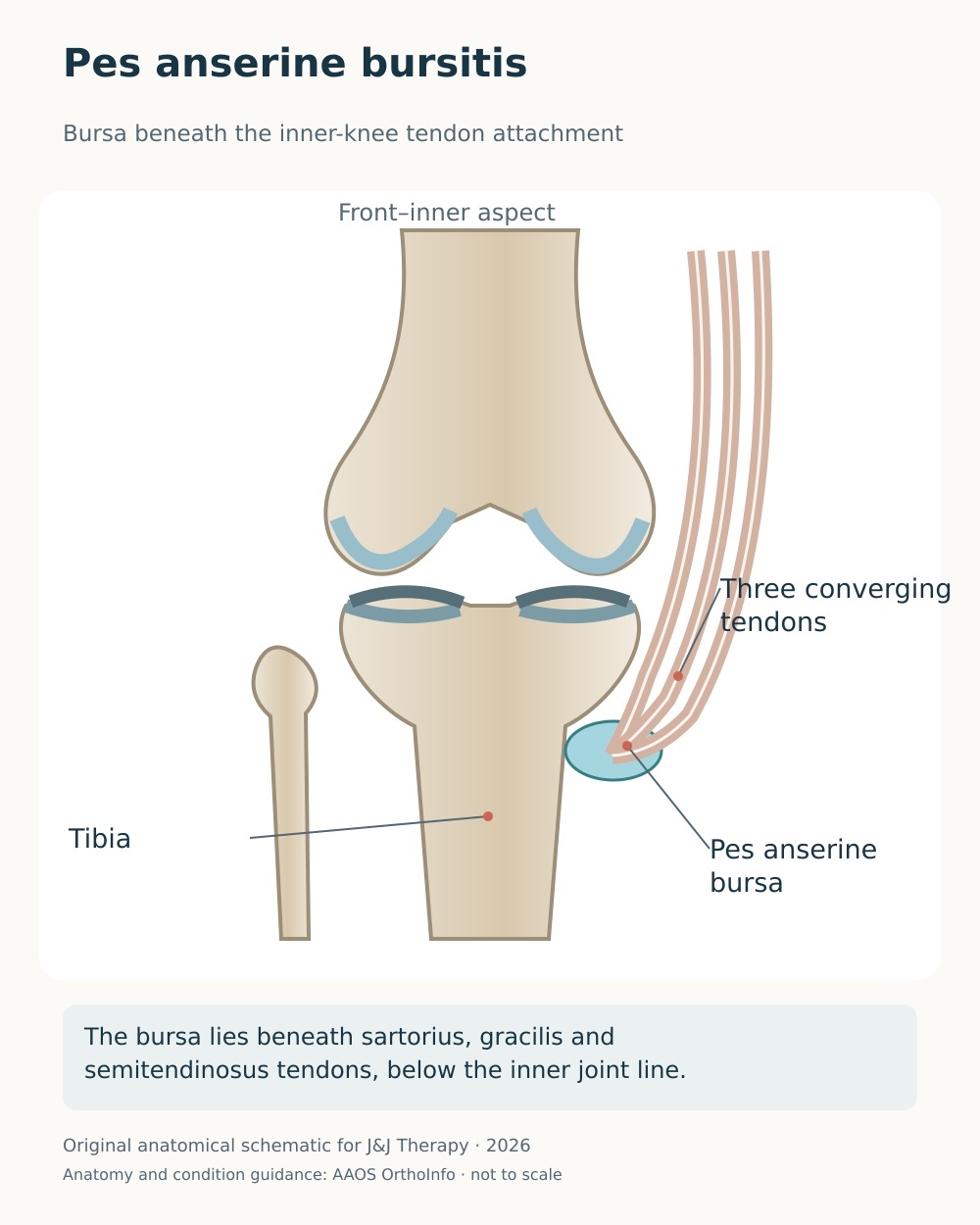
The pes anserinus — meaning "goose's foot" — is the conjoined tendinous insertion of three muscles: sartorius, gracilis, and semitendinosus. These tendons attach onto the anteromedial surface of your shin bone, roughly 5 cm below the inner knee joint line. Deep to these tendons lies the pes anserine bursa, a small fluid-filled sac that reduces friction between the conjoined tendon and the underlying medial collateral ligament during knee movement. When this bursa becomes irritated, it produces excess fluid and causes localised pain on the inner knee.
There is genuine debate about whether the problem is truly bursal. Ultrasound and MRI studies frequently fail to demonstrate bursal inflammation in patients diagnosed clinically, and many authorities now prefer the broader terms pes anserinus pain syndrome or pes anserine tendinobursitis, reflecting that the tendons, the bursa, or both may be involved (Helfenstein & Kuromoto, Revista Brasileira de Reumatologia, 2010). This matters clinically, because it steers treatment away from purely anti-inflammatory thinking and towards addressing tendon load, strength, and biomechanics.
The condition is closely associated with medial knee osteoarthritis, and the size of the bursitis tends to increase with the radiographic severity of the arthritis — one ultrasound study found bursitis in around one in five symptomatic osteoarthritic knees (Uysal et al., Clinical Rheumatology, 2015). The outlook is generally favourable. Evidence suggests that a structured 6–8 week programme of stretching and strengthening resolves symptoms in most patients, and surgery is very rarely required.
Do You Experience These Symptoms?
✓ Pain and tenderness on the inner side of your knee, roughly 5–7 cm below the joint line
✓ Pain that worsens when you climb or descend stairs, or rise from a seated position
✓ Discomfort that increases with running — often after 30–40 minutes — or with repetitive knee bending
✓ A tender spot you can press on the inner shin just below the knee, sometimes with local swelling or warmth
✓ Morning stiffness, or pain that eases with gentle movement but returns after activity
✓ Aching at night, sometimes worse when your knees touch while lying on your side
✓ A feeling of tightness in the inner knee or hamstrings, occasionally with a mild limp
These symptoms can be treated.
The sooner you begin, the better your chances of a smoother recovery.
What Causes Pes Anserine Bursitis?
• Associated knee osteoarthritis
Pes anserine bursitis frequently coexists with medial knee osteoarthritis, and the size of the bursitis tends to increase with the severity of the arthritis.
Research suggests bursitis is present in around one in five symptomatic osteoarthritic knees, so we always assess and manage any underlying arthritis alongside your bursitis.
• Excess body weight and knock-kneed alignment
Additional body weight and a valgus (knock-kneed) alignment increase compressive and frictional load at the pes anserinus insertion.
This helps explain why the condition is most common in middle-aged adults carrying extra weight, and why load correction and weight management are central to a lasting recovery.
• Overuse and training errors
In younger, more active people the condition is usually driven by overuse — repetitive loading of the tendons in bent-knee positions, sudden increases in running mileage, hill running, or side-to-side sports.
These training errors raise friction at the insertion and provoke an inflammatory response that settles once loading is managed properly.
• Type 2 diabetes
Pes anserine tendinobursitis is notably common in people with type 2 diabetes who report knee pain, and the great majority of those affected are women.
Where diabetes is present, optimising your blood sugar control alongside physiotherapy forms a relevant part of management.
• Tight hamstrings and weak hip abductors
Tightness through the hamstring group is thought to increase pressure and friction on the underlying bursa, while weakness of the hip abductors alters lower-limb control and overloads the inner knee.
Both are directly modifiable, which is why they form a core part of the exercise programme we build for you.
How We Treat Pes Anserine Bursitis at J&J Therapy
Hands-On Manual Therapy
Hands-on soft-tissue mobilisation of the hamstring, adductor, and calf groups to reduce tension around the pes anserinus, combined with gentle knee, patellofemoral, and hip mobilisation to restore comfortable movement — creating the window in which you can load and strengthen effectively.
Shockwave Therapy*
Swiss Storz Medical MASTERPULS
may complement your manual therapy and exercise programme for persistent cases, when your physiotherapist identifies suitable indications during assessment. Research in this area is limited, so it is considered a second-line option rather than a first-line treatment.
Non-invasive, evidence-based.
Targeted Exercise Programme
A graded programme starting with pain-relieving isometric holds, progressing to controlled isotonic strengthening of the quadriceps, hamstrings, and calf, with targeted hip abductor and adductor work, hamstring and adductor flexibility, gait and footwear review, and structured return-to-running guidance.
When to Seek Urgent Medical Help
While most symptoms are not serious, urgent medical attention is required if you experience any of the following:
A hot, red, swollen knee with fever or chills (possible infection of the bursa)
Calf pain, swelling, warmth, or redness — particularly after surgery, immobility, or long travel
Severe pain that stops you bearing weight, or a knee that suddenly locks or gives way
Rapid, unexplained swelling or intense inner-knee pain that is out of proportion to your activity
FAQs About Pes Anserine Bursitis
Is pes anserine bursitis serious, and will it go away?
For most people it is not serious and settles with conservative care. It is generally a self-limiting condition, and evidence shows that a structured stretching and strengthening programme relieves symptoms in most patients over roughly 6–8 weeks. Recovery can take longer where there is coexisting knee osteoarthritis or general deconditioning.
Why does it hurt more on the stairs?
Climbing and descending stairs, and rising from a chair, load the inner-knee tendons and compress the bursa — which is why these movements typically reproduce your pain. Temporarily modifying these loads while you build strength usually helps settle symptoms.
Do I need a scan?
Often not — the diagnosis is usually made clinically from your history and examination. However, because the symptoms can mimic osteoarthritis, a meniscal problem, or a stress fracture, your physiotherapist may recommend imaging such as ultrasound or MRI if the picture is unclear or you are not improving as expected.
Can shockwave therapy help my pes anserine bursitis?
It may help in persistent cases. Research suggests radial shockwave therapy can reduce pain in pes anserine bursitis and closely related tendon conditions, but the studies are small and it is not a first-line or stand-alone treatment. We would only consider it, using our Swiss Storz Medical MASTERPULS system, after assessing you, confirming the diagnosis, and checking there is no reason to avoid it — always alongside your exercise programme.
What can I do at home to help?
Relative rest from the activities that aggravate your knee, ice over the tender area, and keeping gently active all help in the early stages. The most important step is following the individualised stretching and strengthening plan your physiotherapist gives you, as consistency over several weeks is what drives your recovery.
This page is for general information only and does not replace professional medical advice.
Reviewed by Lavya Arigalayan, MSc, HCPC Registered Physiotherapist.
Last reviewed:
2026년 8월 20일