Quick Summary
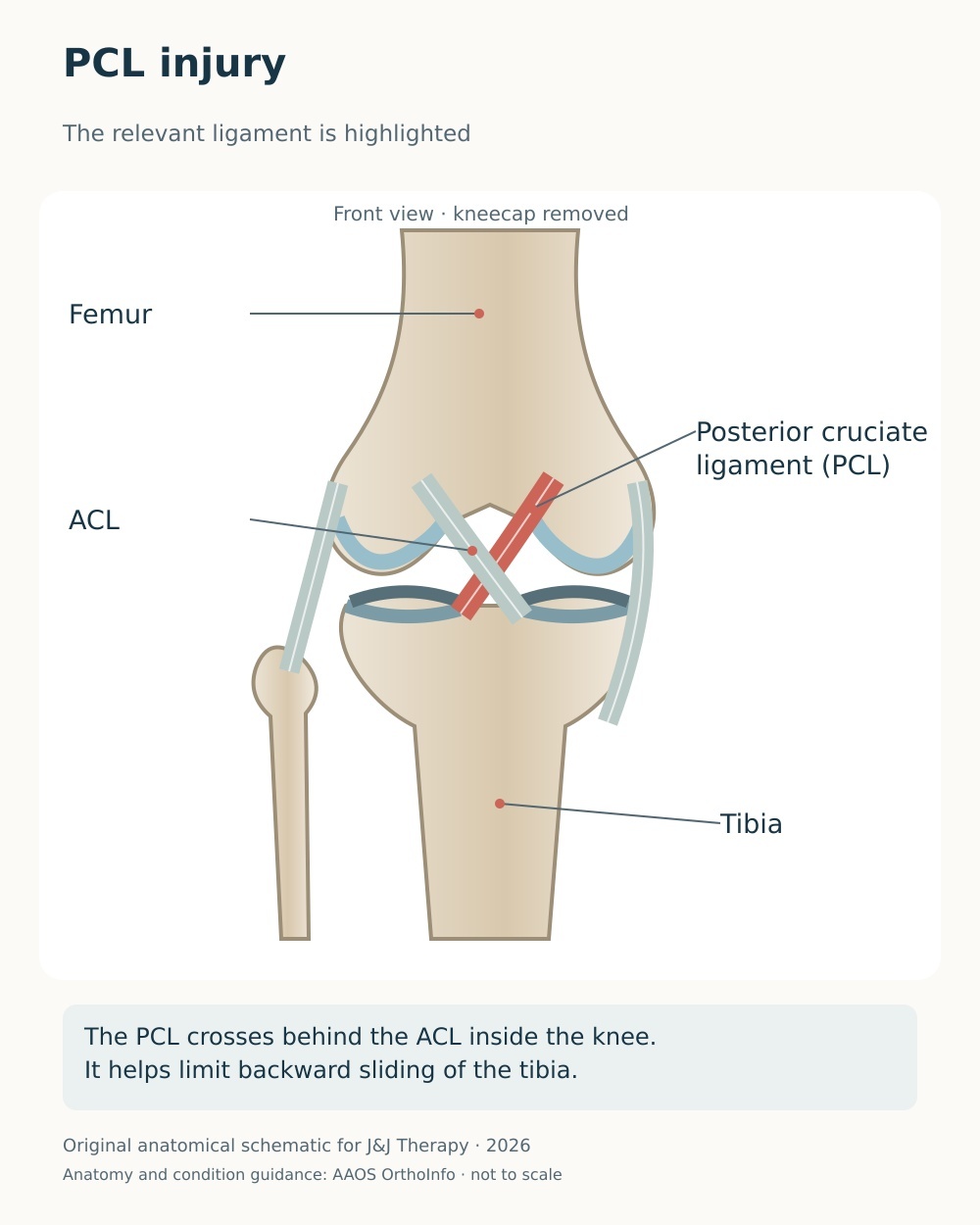
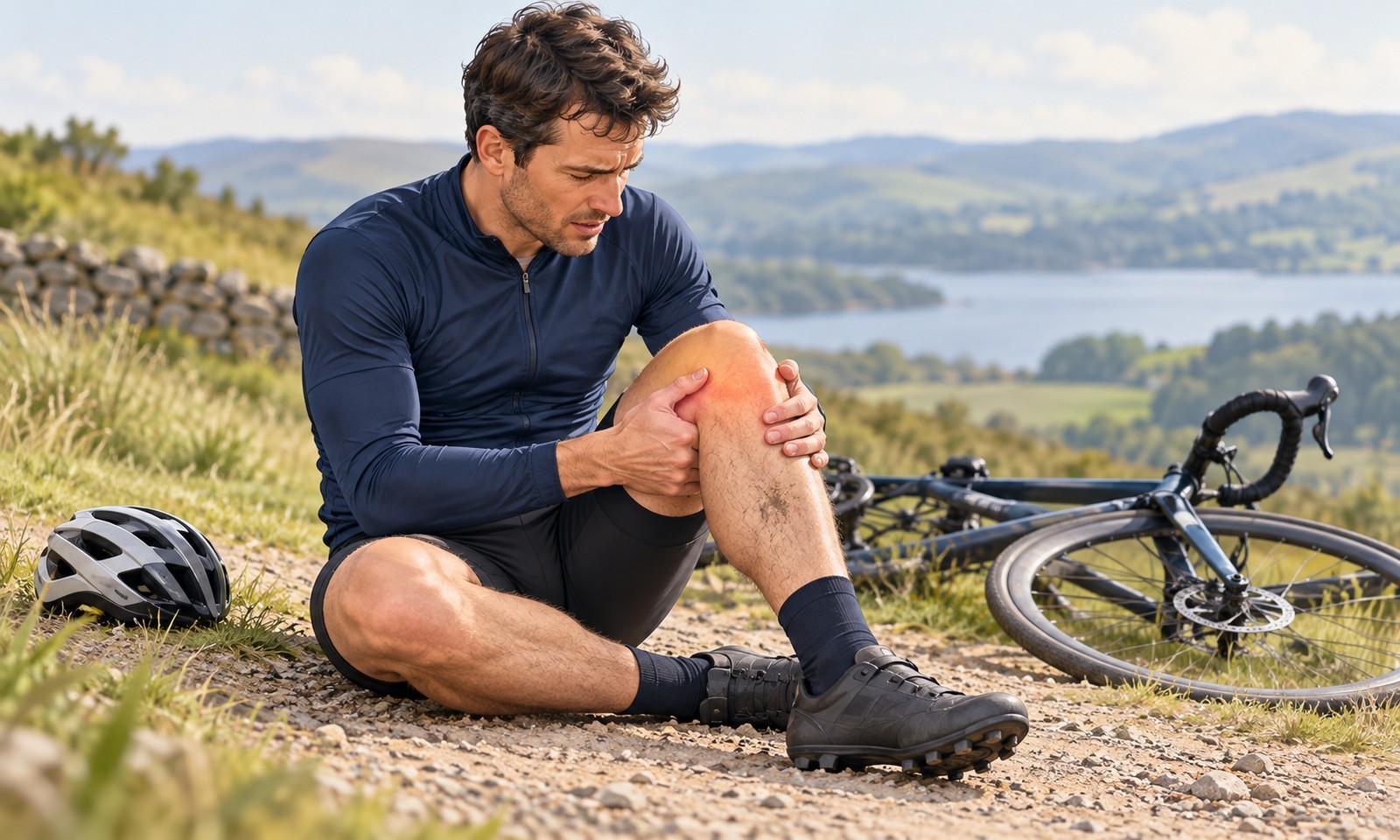
A posterior cruciate ligament (PCL) injury affects the strong ligament at the back of your knee that stops your shin bone sliding backwards. It usually follows a blow to the front of a bent knee, a fall onto the kneecap, or a twisting injury in sport.
Most isolated PCL injuries settle well without surgery, and research suggests that quadriceps-focused physiotherapy is the cornerstone of recovery. Our physiotherapists assess your knee thoroughly, grade the injury where possible, and build a staged programme of manual therapy and targeted exercise. Where your assessment indicates it may help, additional treatments are considered alongside your core programme.
What Is a PCL Injury?
The posterior cruciate ligament is the largest and strongest ligament in your knee. It runs from the inner side of your thigh bone to the back of your shin bone, and its main job is to stop the shin bone sliding backwards beneath the thigh bone. It works alongside the anterior cruciate ligament, the posterolateral corner and the popliteus muscle to keep the joint stable through movement.
PCL injuries are far less common than ACL injuries. Population-based research reports an annual incidence of isolated complete PCL tears of around 1.8 per 100,000 people (Sanders et al., Knee Surgery, Sports Traumatology, Arthroscopy, 2017), and the great majority of PCL injuries occur alongside damage to other ligaments, cartilage or the meniscus rather than on their own. Because the symptoms are often milder than an ACL rupture, PCL tears are commonly missed at first presentation.
How PCL injuries are graded
Injuries are graded by how far the shin bone can be pushed backwards during examination. Grade I is a partial tear with slight movement, Grade II a complete isolated tear with moderate movement, and Grade III a large movement that usually signals a combined injury involving other structures. In broad terms, Grade I and II isolated injuries are managed without surgery, while Grade III, combined injuries and displaced bony avulsions are referred for a surgical opinion (Eberle et al., Knee Surgery, Sports Traumatology, Arthroscopy, 2026).
What happens over time
The outlook for an isolated PCL injury is generally favourable. Long-term follow-up of patients treated without surgery found moderate to severe osteoarthritis in around 11 per cent at an average of 14 years, with outcomes not determined by the degree of remaining laxity (Shelbourne et al., American Journal of Sports Medicine, 2013). Because a lax PCL shifts load onto the inner and kneecap compartments of the joint, evidence shows that maintaining quadriceps strength is central to protecting the knee over the long term.
Do You Experience These Symptoms?
✓ Pain and swelling at the back of the knee, often milder than an ACL tear
✓ A feeling of instability or giving way, especially on stairs and slopes
✓ Discomfort with deep squatting, kneeling or crouching
✓ Stiffness and reduced movement in the early weeks after injury
✓ A sense that the shin bone sags backwards when the knee is bent
✓ Aching at the front of the knee around the kneecap in longer-standing injuries
✓ Reduced confidence with running, pivoting or slowing down in sport
These symptoms can be treated.
The sooner you begin, the better your chances of a smoother recovery.
What Causes a PCL Injury?
• Dashboard injury
A direct backward blow to the front of a bent shin drives the shin bone behind the thigh bone and tears the ligament. This classically happens when the knee strikes the dashboard in a car collision and often involves higher-energy trauma.
• Falling onto a bent knee
Landing on the front of a bent knee with the foot pointed downwards transmits force straight through the shin bone and on to the PCL. This is a common everyday and sporting mechanism, and it typically produces an isolated injury.
• Hyperflexion and hyperextension
Forcing the knee into extreme bending, or violently over-straightening it, can overload the ligament beyond its limit. Hyperextension injuries are more likely to involve other structures at the back and outer side of the knee.
• Contact and twisting in sport
Football, rugby, skiing and motorcycling account for many PCL injuries through direct contact, awkward landings and high-speed impacts. Because the initial symptoms can be modest, these injuries are sometimes not identified until later.
• Previous knee injury or instability
A knee that has already been injured, or one with weak quadriceps and poor control, is less able to absorb the forces that stress the PCL. Research suggests that restoring strength and control reduces the load passing through the ligament.
How We Treat PCL Injury at J&J Therapy
Hands-On Manual Therapy
Our physiotherapists use hands-on treatment to support your recovery alongside your exercise programme. In the early phase we work to settle pain and swelling, because fluid in the joint strongly contributes to the reflex switching off of the quadriceps that follows a knee injury. We use gentle kneecap and knee joint mobilisation within safe ranges, soft tissue work to the surrounding muscles, and careful gait re-education so you can walk comfortably and evenly again. Throughout, we protect the healing ligament by avoiding positions and forces that push the shin bone backwards. Manual therapy is always combined with active rehabilitation rather than used on its own.
Shockwave Therapy*
Shockwave therapy is not a first-line treatment for a PCL injury. The ligament sits deep at the back of the knee, beyond the reach of radial shockwave, and we do not treat directly over the nerves and blood vessels behind the knee. Where your assessment identifies a separate, accessible problem alongside your PCL injury, such as a persistent tendon issue, our Swiss Storz Medical MASTERPULS may be considered as an adjunct to your exercise programme. Evidence in this setting is limited, so any use is decided individually after examination.
Targeted Exercise Programme
Targeted exercise is the most important part of PCL rehabilitation, and your programme is quadriceps-focused by design. Because the quadriceps pulls the shin bone forwards, it counteracts the backward sag caused by a lax PCL and helps protect the healing ligament. For the same reason we are cautious with early isolated hamstring curls and open-chain knee bending, which pull the shin bone backwards, and introduce them gradually later. Early sessions focus on controlling swelling, restoring protected range and reactivating the quadriceps. We then progress to closed-chain strengthening such as mini-squats, step-downs and leg press, followed by balance and proprioceptive work, then heavier strengthening, hopping and sport-specific drills. Return to sport is based on criteria rather than the calendar, and research suggests a return to competitive sport after conservative management commonly takes around 16 to 22 weeks depending on grade and progress.
When to Seek Urgent Medical Help
While most symptoms are not serious, urgent medical attention is required if you experience any of the following:
Gross instability, a knee that gives way completely, or an obvious deformity, which may indicate a dislocated or multi-ligament knee and needs emergency assessment
A cold, pale or pulseless foot, or numbness, tingling or an inability to lift your foot, which may indicate injury to the blood vessels or nerves behind the knee
A locked knee, an inability to put weight through the leg, or rapid tense swelling of the joint after injury
Severe or worsening calf pain and tightness out of proportion to the injury
FAQs About PCL Injury
Do I need surgery for a PCL injury?
Usually not. Most isolated Grade I and II PCL injuries are managed successfully without surgery using a structured, quadriceps-focused physiotherapy programme, and evidence shows that long-term outcomes are generally good. Surgery is more often considered for complete Grade III tears with instability, combined ligament injuries, displaced bony avulsions, or when conservative treatment does not settle your symptoms. We will assess your knee and, where appropriate, refer you for a surgical opinion.
How long does recovery take?
It depends on the grade of injury and your goals. Many people regain comfortable day-to-day function within a few weeks to months, while research suggests that return to competitive sport after an isolated injury commonly takes around 16 to 22 weeks. Your progress is judged on strength, control and confidence rather than time alone.
Why do you focus so much on the quadriceps?
Because the quadriceps actively pulls your shin bone forwards, it directly counteracts the backward sag caused by a weakened PCL and helps protect the healing ligament. Maintaining quadriceps strength is also linked with better long-term knee health. This is why we prioritise the quadriceps and are careful with early isolated hamstring and open-chain exercises, which can strain the ligament.
Can shockwave therapy treat my PCL?
No. Shockwave is not a treatment for the PCL itself: the ligament lies deep at the back of the knee, beyond the reach of radial shockwave, and for safety reasons we do not treat over the nerves and blood vessels behind the knee. If your assessment identifies a separate, accessible problem such as a lingering tendon issue, our Swiss Storz Medical MASTERPULS may be used as an adjunct to your exercise programme.
Will I develop knee arthritis later?
There is some increased long-term risk, mainly in the inner and kneecap compartments, because a lax PCL changes how load passes through the joint. However, this is not inevitable: long-term follow-up found moderate to severe changes in around 11 per cent of patients at an average of 14 years, and evidence suggests that strong quadriceps are protective. Building and maintaining that strength is a core aim of your programme.
This page is for general information only and does not replace professional medical advice.
Reviewed by Lavya Arigalayan, MSc, HCPC Registered Physiotherapist.
Last reviewed:
2026년 8월 20일