Quick Summary
Patellar tendinopathy — commonly known as jumper's knee — is a load-related overuse condition of the tendon connecting your kneecap to your shin bone, causing pain just below the kneecap during jumping, running, squatting and stairs. It is most common in jumping and court sports, affecting around 14% of elite athletes and 8.5% of recreational athletes. Our HCPC-registered physiotherapists combine hands-on manual therapy, a progressive tendon-loading programme and shockwave therapy where indicated — typically 3–6 shockwave sessions alongside your exercise programme.
What Is Patellar Tendinopathy?
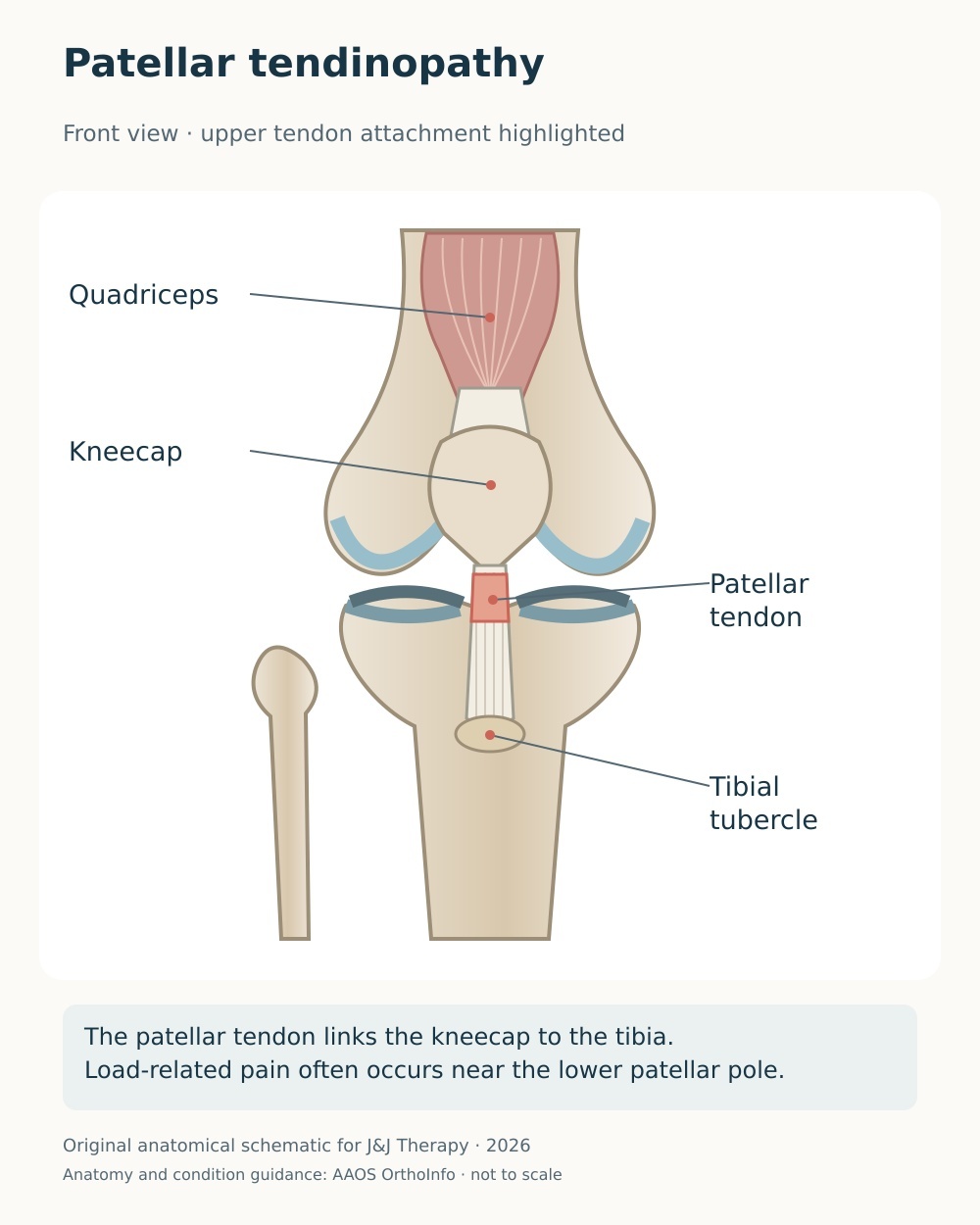
Patellar tendinopathy — often called jumper's knee — is a load-related disorder of the patellar tendon, the strong band running from the lower pole of your kneecap to the top of your shin bone as part of the knee extensor mechanism.
It is typically felt as well-localised pain at the inferior pole of the patella that increases with activities loading the knee extensors — jumping, landing, squatting, running and stairs.
Modern understanding has moved away from the older term "tendinitis". Studies of symptomatic tendons consistently show a degenerative rather than inflammatory picture: disorganised collagen fibres, increased mucoid ground substance, a shift from stronger type I to weaker type III collagen, new blood-vessel and nerve in-growth, and a notable absence of the inflammatory cells that would define a true "-itis" (Khan et al., Sports Medicine, 1999). This is why the condition is correctly termed a tendinopathy.
The most widely used framework is the tendon continuum model (Cook & Purdam, British Journal of Sports Medicine, 2009), which describes three overlapping, load-driven stages:
Stage 1 — Reactive tendinopathy: a short-term, non-inflammatory thickening in response to acute overload, which is reversible with sensible load management.
Stage 2 — Tendon dysrepair: attempted healing with matrix breakdown and some new blood-vessel formation.
Stage 3 — Degenerative tendinopathy: areas of cell death and disorganised matrix with limited capacity to reverse.
Symptoms are also staged clinically by when pain occurs (Blazina et al., 1973): pain only after activity; pain at the start of activity that eases with warm-up and returns with fatigue; pain during and after activity with impaired performance; and, at the most severe end, patellar tendon rupture.
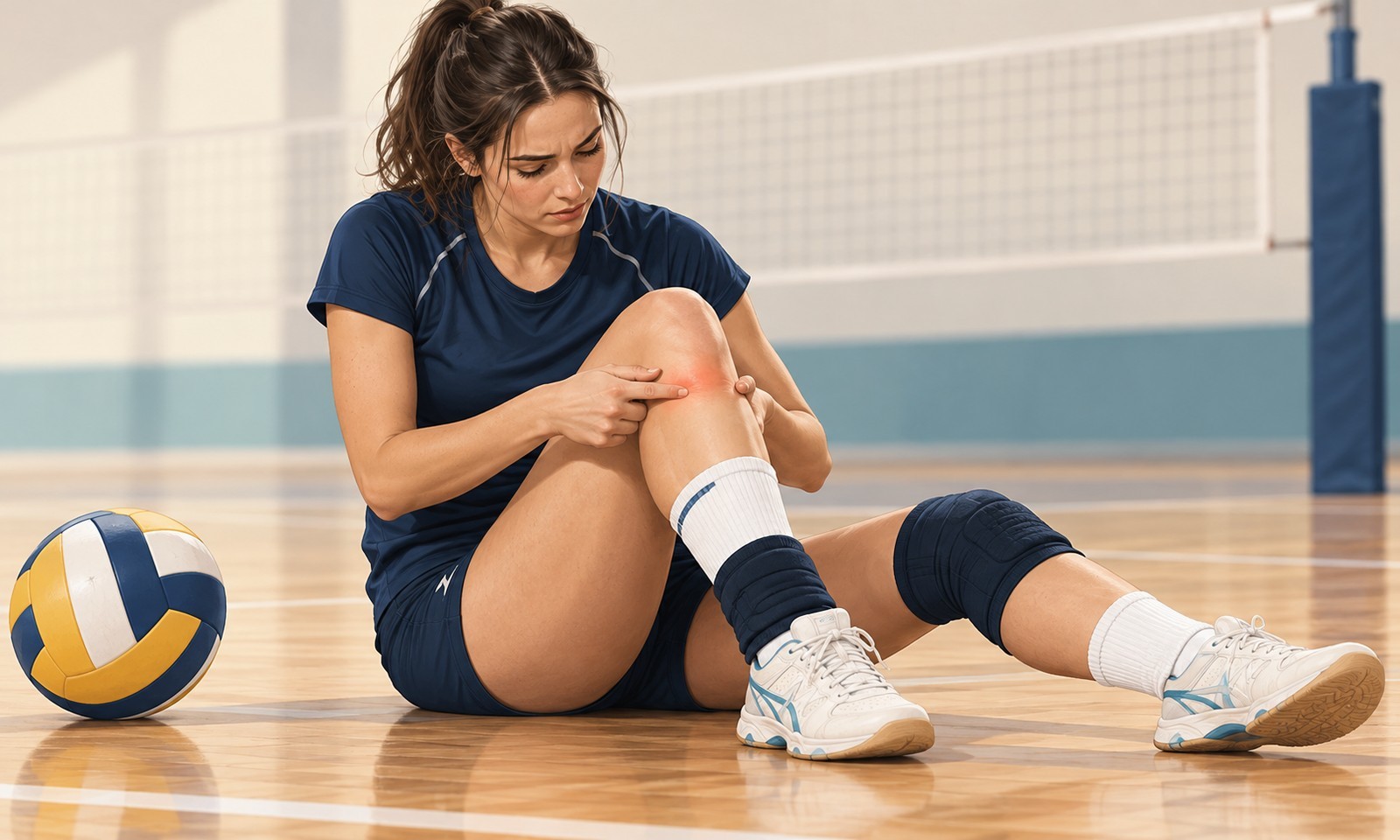
Patellar tendinopathy is strongly associated with jumping and court sports. Research in elite athletes found an overall prevalence of 14.2%, rising to 44.6% in volleyball and 31.9% in basketball, and it was more than twice as common in men (Lian et al., American Journal of Sports Medicine, 2005). Among recreational athletes prevalence was 8.5% (Zwerver et al., American Journal of Sports Medicine, 2011). It mainly affects active people aged roughly 15 to 30, and can be persistent — elite athletes reported a mean symptom duration of around 32 months, which is why early, guided management matters.
Do You Experience These Symptoms?
✓ Pain and tenderness localised just below your kneecap, at the lower pole of the patella
✓ Pain brought on by loading — jumping, landing, squatting, running, hopping or going down stairs — which usually eases soon after the activity stops
✓ Pain that is dose-dependent: worse with faster, heavier or single-leg loading, with a single-leg decline squat often the most provocative test
✓ Morning stiffness in the knee, or stiffness after sitting for long periods (sometimes called the theatre sign)
✓ A warm-up effect — pain that eases as you get going but returns, often worse, afterwards
✓ Localised thickening or swelling over the tendon in some cases
✓ Reduced jumping, sprinting or sporting performance as the condition progresses
These symptoms can be treated.
The sooner you begin, the better your chances of a smoother recovery.
What Causes Patellar Tendinopathy?
• Sudden increases in training load
The strongest driver is a rapid rise in the volume, frequency or intensity of loading relative to what your tendon is accustomed to.
When load repeatedly exceeds the tendon's capacity to recover, cumulative microdamage outpaces adaptation and symptoms develop.
• Repetitive energy-storage and jumping activity
Sports that repeatedly store and release energy in the patellar tendon — volleyball, basketball, netball, athletics jumps and explosive change-of-direction sports — place very high demands on the tendon.
Volleyball players, for example, may perform 250–300 jumps in a single five-set match, concentrating stress at the lower pole of the kneecap.
• Biomechanical and kinetic-chain factors
Reduced ankle dorsiflexion, tight calf and quadriceps muscles, limited hip mobility or weak hip and gluteal muscles can shift load onto the patellar tendon during landing.
Poor landing mechanics and stiff, hard playing surfaces have also been associated with a higher prevalence.
• Individual risk factors
Male sex, higher body weight, greater vertical-jump ability and a previous history of tendon pain all increase your risk.
These factors interact with training load, which remains the most significant and most modifiable contributor.
How We Treat Patellar Tendinopathy at J&J Therapy
Hands-On Manual Therapy
Targeted soft-tissue mobilisation of the quadriceps, calf and surrounding structures, plus mobilisation of the knee, hip and ankle where restrictions are loading your tendon — used to ease pain and improve mobility so you can engage fully with your loading programme.
Shockwave Therapy*
Swiss Storz Medical MASTERPULS
to deliver radial acoustic pressure waves to the patellar tendon, which research suggests may stimulate local blood flow and the tendon's natural healing response while helping to reduce pain.
Non-invasive, evidence-based. Typically 3–6 sessions.
Targeted Exercise Programme
A staged, individualised loading programme — isometric holds for early pain relief, heavy slow resistance to rebuild tendon capacity, then progressive energy-storage and sport-specific work — alongside hip, calf and ankle mobility work to reduce load on the tendon.
When to Seek Urgent Medical Help
While most symptoms are not serious, urgent medical attention is required if you experience any of the following:
Signs of patellar tendon rupture — a sudden pop during a jump or fall, severe pain, marked swelling, a gap felt below the kneecap, or inability to straighten your knee or lift your straight leg
A hot, red, swollen knee with fever or feeling generally unwell (possible infection)
Knee pain after significant trauma, or a knee that locks, gives way or cannot take your weight
Pain that is constant, present at rest, wakes you at night, or comes with unexplained weight loss — and any anterior knee pain in a child or teenager
FAQs About Patellar Tendinopathy
How long does patellar tendinopathy take to recover?
Recovery is usually gradual. With appropriate loading, many people improve significantly over 3–6 months, though long-standing cases can take 6–12 months as the tendon remodels slowly. Continuing to play through significant pain tends to prolong recovery, so early, guided load management helps.
Should I rest completely?
Usually not. Tendons respond poorly to complete rest and generally need controlled load to recover. Rather than stopping altogether, our physiotherapists help you modify and manage your load while progressively rebuilding the tendon's capacity.
Is it the same as Osgood-Schlatter disease?
No. Osgood-Schlatter disease and Sinding-Larsen-Johansson syndrome are growth-plate conditions in children and adolescents, affecting the tendon's attachments at the shin and the lower kneecap respectively. Patellar tendinopathy is a degenerative tendon condition, typically in older adolescents and adults. Accurate diagnosis matters because it changes treatment — including whether shockwave therapy is appropriate.
Does shockwave therapy help jumper's knee?
The evidence is mixed but, on balance, supportive. A recent systematic review and meta-analysis reported clinically meaningful improvements in both pain and function with extracorporeal shockwave therapy, while some trials found little benefit — particularly in athletes with shorter-duration symptoms who continued competing. Research suggests shockwave may help most as an adjunct to a loading programme in longer-standing cases that have not responded to exercise alone. It is non-invasive and typically involves 3–6 sessions. Your physiotherapist will assess whether it is suitable for you, and it is not used over active growth plates in young patients.
Will I need a scan?
Often not. Patellar tendinopathy is primarily a clinical diagnosis based on your history and examination, including a single-leg decline squat. Ultrasound or MRI may be used in selected cases to confirm the diagnosis or rule out other causes, but imaging findings do not always match symptoms, so we interpret them alongside your clinical picture.
This page is for general information only and does not replace professional medical advice.
Reviewed by Lavya Arigalayan, MSc, HCPC Registered Physiotherapist.
Last reviewed:
2026년 8월 20일