
Quick Summary
Rebuilding confidence after your kneecap has slipped out of place starts with the right medical checks, followed by rehabilitation matched to your injury. Our physiotherapists in New Malden can assess your symptoms and help you choose appropriate next steps for your goals. We agree practical goals and review your progress.
Understanding Patella Dislocation / Subluxation
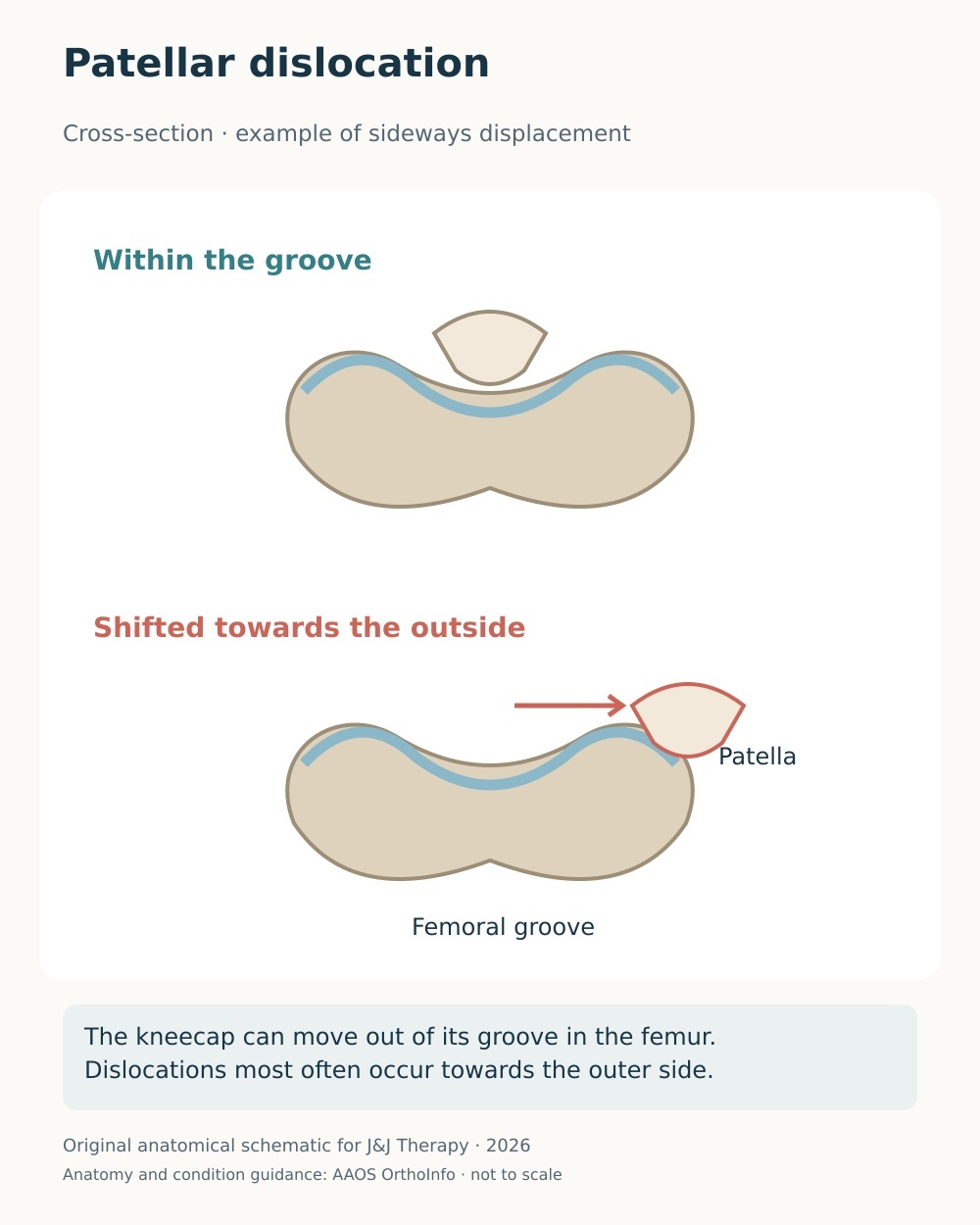
The patella is the kneecap at the front of your knee. A dislocation means it leaves its groove; a subluxation is a partial slip. Either can injure the tissues that help guide the kneecap, and sometimes the cartilage or bone. A first dislocation needs medical assessment even if the kneecap moves back by itself.
Assessment at J&J Therapy
Once the acute injury has been checked, we review your medical advice, swelling, movement and leg control. We discuss whether recurrent episodes, locking or persistent swelling need orthopaedic review before progressing exercise.
Do You Experience These Symptoms?
- A sudden sideways movement of the kneecap with pain or swelling.
- Apprehension when turning, descending stairs or straightening the knee.
- Repeated slipping episodes or difficulty trusting the leg.
An assessment helps guide your next step, based on your symptoms, health and goals.
Treatment and rehabilitation options
Hands-On Manual Therapy
Gentle hands-on care may help comfortable movement after the injury has been assessed. It does not reposition an acutely dislocated kneecap or replace rehabilitation. Pressure and movement are adapted to any brace or surgical restrictions. We explain the purpose and check your comfort and response throughout treatment.
Is Shockwave Suitable?
Shockwave is not a routine treatment for a dislocated or unstable kneecap. The priority is appropriate medical assessment, protection and progressive rehabilitation. Your physiotherapist can explain the more suitable options and how their effect will be reviewed during your ongoing rehabilitation.
Targeted Exercise Programme
Rehabilitation progresses from comfortable knee movement and thigh activation to leg strength, balance and controlled turning or landing. Return to sport depends on function, confidence and clinical advice rather than a fixed number of appointments. Your home plan is adapted as your function and confidence improve.
When to Seek Urgent Medical Help
While most symptoms are not serious, urgent medical attention is required if you experience any of the following:
- Go to A&E if the knee is visibly out of shape, rapidly very swollen, or severely injured. Do not try to push the kneecap back.
- Seek NHS 111 advice promptly after a suspected dislocation, including one that reduced itself.
- A cold, pale or numb foot after injury needs emergency assessment.
Your questions answered
Do I need help if it went back into place?
Yes. A new dislocation can damage cartilage or bone even if the kneecap returns to its usual position. Seek prompt medical advice before arranging rehabilitation.
Will I need surgery?
Many people are managed without surgery, but recurrent dislocation or associated damage may require an orthopaedic opinion. We can support rehabilitation alongside the agreed treatment plan.
Which appointment should I book?
For a new or suspected kneecap dislocation, seek medical assessment first, even if the kneecap has returned to position. Once the injury has been checked and the protection plan is clear, book a Physiotherapy Initial Assessment for rehabilitation. Bring the medical advice and any brace instructions.
Book a Physiotherapy Assessment for rehabilitation after medical assessment, or call our reception team on 07935 869938 for booking help.
Related conditions
Patellofemoral Pain Syndrome (Runner’s Knee) · Knee Cartilage Injury
Sources and further reading

This page is for general information only and does not replace professional medical advice.
Information updated 15 October 2026. General information only; this page cannot diagnose your symptoms. Treatment is agreed after assessment. For urgent or severe symptoms, use the medical services described above.