Quick Summary
Non-specific low back pain is pain between your lower ribs and buttock creases that cannot be traced to a single identifiable disease or structural cause — which is the case in the large majority of episodes. Up to 80% of people in the UK experience low back pain at some point, and most episodes improve substantially within 6 to 12 weeks. Our physiotherapists assess your movement, strength and contributing lifestyle factors, then combine hands-on manual therapy with a progressive exercise programme — the approaches with the strongest evidence. Most patients see meaningful improvement within 6–12 sessions alongside a home exercise programme.
What Is Non-Specific Low Back Pain?
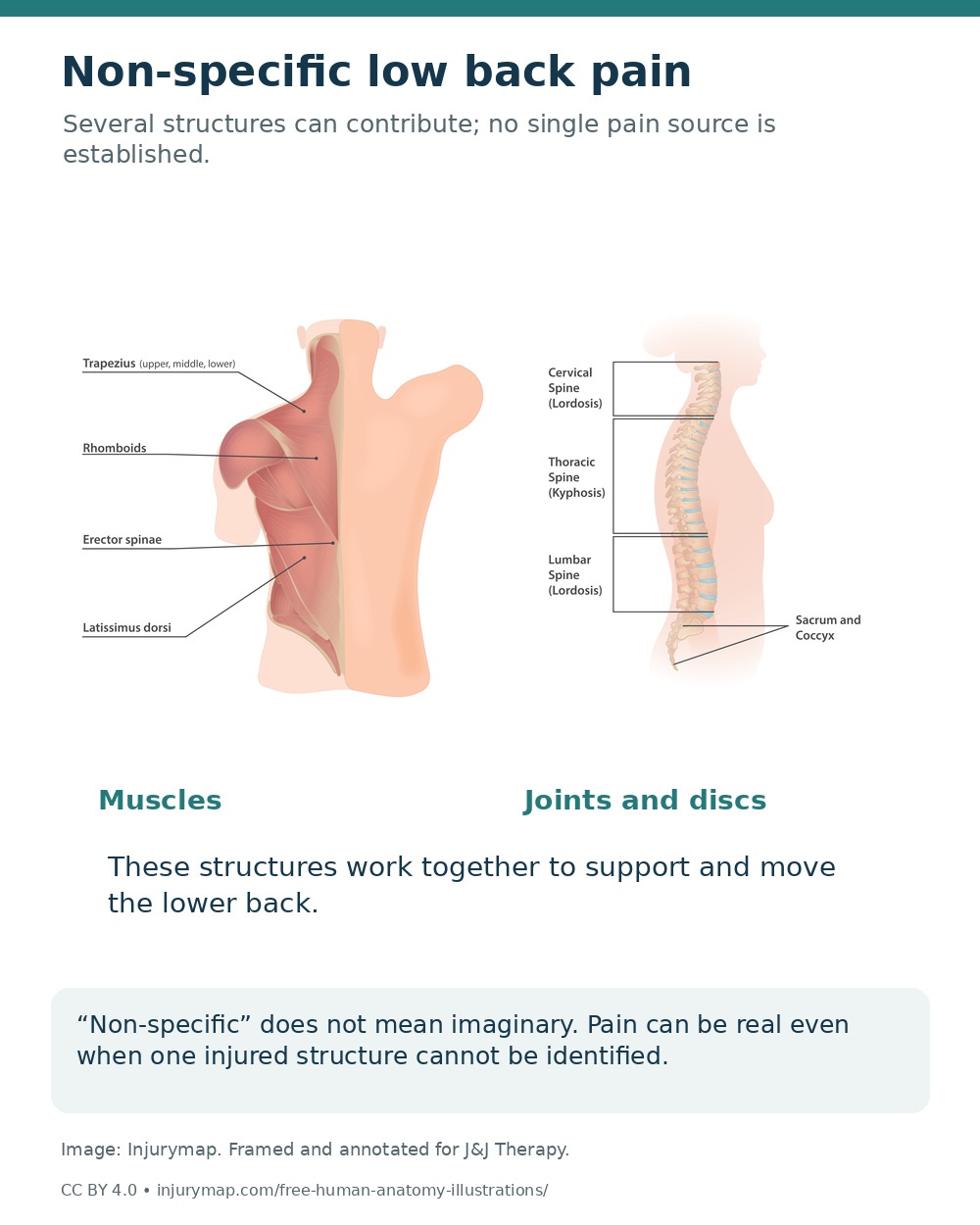
Non-specific low back pain is defined as low back pain that is not attributable to a recognisable, known specific pathology such as infection, tumour, osteoporosis, fracture, structural deformity, inflammatory disorder, radicular syndrome or cauda equina syndrome. Up to 90% of low back pain cases are non-specific, meaning there is no single clear source for the pain.
Several structures — joints, discs, muscles, ligaments and connective tissue — may contribute, but imaging often cannot pinpoint the source. Structural findings such as disc degeneration or bulges are common in people with no pain at all, which is why routine scans are not recommended for most cases.
Why we look at the whole picture
Current understanding uses a biopsychosocial model: pain and disability are shaped not only by physical loading and tissue sensitivity, but also by psychological factors such as fear of movement or low mood, and by your social and occupational context (Hartvigsen et al., The Lancet, 2018). In persistent cases, central sensitisation — an amplified responsiveness of the nervous system — is thought to contribute to why symptoms can outlast the original trigger.
How it is staged
Low back pain is described by duration: acute (less than 6 weeks), subacute (6–12 weeks) and chronic (12 weeks or more). The outlook is generally reassuring — research shows rapid improvement in the first month, with a mean reduction of around 58% in both pain and disability scores and further, slower improvement up to about three months (Pengel et al., BMJ, 2003).
Recurrence is common, however. One study reported a one-year recurrence rate of 33% (da Silva et al., Physical Therapy, 2017), and a minority of people go on to develop persistent, disabling pain. This is why NICE recommends matching the intensity of treatment to your individual risk of a poor outcome rather than treating every episode the same way (NICE NG59, 2016, updated 2020). Low back pain remains the leading single cause of years lived with disability in the UK, with NHS costs estimated at around £3.2 billion each year.
Do You Experience These Symptoms?
✓ Persistent ache, stiffness or sharp pain in your lower back that limits your daily activities
✓ Pain that varies with posture, movement or position, and often eases with gentle activity
✓ Stiffness that is worst after rest — first thing in the morning, or after sitting for a long time
✓ Muscle tension, tightness or spasm across your lower back
✓ Pain that spreads into your buttock or upper thigh, without the shooting leg-dominant pattern of sciatica
✓ Difficulty with everyday tasks such as bending, lifting, standing or sitting for long periods
✓ Symptoms that flare intermittently — settling for a while, then returning
These symptoms can be treated.
The sooner you begin, the better your chances of a smoother recovery.
What Causes Non-Specific Low Back Pain?
• Mechanical and postural loading
Everyday strain from awkward lifting, bending, twisting or sustained postures can overload the muscles, joints and soft tissues of your lower back.
These loads rarely cause lasting damage, but they can sensitise the tissues and trigger a painful episode.
• Deconditioning and sedentary behaviour
Low physical activity, weak trunk and hip muscles and prolonged sitting reduce your back’s tolerance to load.
This can create a cycle in which pain leads to less activity, which in turn makes the back less resilient.
• Occupational factors
Physically demanding work involving heavy manual handling, whole-body vibration, repetitive bending or prolonged static positions raises the risk of low back pain.
Desk-based work is not exempt — long periods in one position without movement breaks are a common contributor.
• Psychosocial factors
Fear of movement, worry about damage, low mood, stress and low expectations of recovery are among the strongest predictors of an episode becoming persistent.
Addressing these alongside the physical treatment is a recognised part of effective care.
• Lifestyle and general health
Obesity, smoking, higher initial pain intensity and having had a previous episode all increase the likelihood of developing or maintaining low back pain.
Many of these factors are modifiable, and improving them supports both recovery and longer-term prevention.
How We Treat Non-Specific Low Back Pain at J&J Therapy
Hands-On Manual Therapy
Hands-on manual therapy
including spinal mobilisation and soft-tissue techniques to ease pain, reduce muscle guarding and restore comfortable movement.
Always delivered as part of a package with exercise, in line with NICE guidance.
Shockwave Therapy*
Swiss Storz Medical MASTERPULS
may complement your manual therapy and exercise programme when your physiotherapist identifies specific indications — such as a myofascial or muscular component — during your assessment.
Applied to the paraspinal soft tissues. Non-invasive, evidence-based. Never used as a stand-alone or first-line treatment.
Targeted Exercise Programme
Targeted exercise programme
built around your presentation and preferences — motor control, strengthening, mobility and aerobic work all have supporting evidence, and no single type is clearly superior.
Recommended by NICE as a first-line treatment, with education and advice to stay active.
When to Seek Urgent Medical Help
While most symptoms are not serious, urgent medical attention is required if you experience any of the following:
Difficulty passing urine, loss of bladder or bowel control, or numbness around your back passage, buttocks or genitals — seek emergency care immediately
New numbness or weakness in both legs, or progressive weakness, numbness or unsteadiness when walking
Unexplained weight loss, a history of cancer, fever or feeling generally unwell alongside your back pain
Back pain following significant trauma such as a fall or road traffic collision
Pain that is markedly worse at night and in the early morning with prolonged morning stiffness, particularly in a younger adult
FAQs About Non-Specific Low Back Pain
Should I rest or stay active with low back pain?
Stay as active as you can. Both NHS and NICE guidance are clear that continuing your normal activities as much as possible speeds recovery, whereas prolonged bed rest tends to make pain last longer. Gentle movement and a gradual return to activity are part of getting better — hurt does not necessarily mean harm.
Do I need an MRI or X-ray?
Usually not. NICE advises against routine imaging for non-specific low back pain in non-specialist settings, because scans often reveal age-related changes that are equally common in people with no pain and can be misleading. Imaging is reserved for cases with red-flag features, or where the result would genuinely change your management.
How long will it take to get better?
Most episodes improve substantially within 6 to 12 weeks, with the fastest improvement usually in the first few weeks. Recovery is not always linear, and good days and bad days are normal. If your pain has not improved after around 6 weeks of staying active and self-managing, that is a sensible point to seek assessment.
Will my back pain come back?
It can. Research suggests around one in three people have another episode within a year. Staying active, maintaining strength and addressing contributing factors such as deconditioning or prolonged sitting can reduce how often episodes occur, how long they last and how severe they are.
Can shockwave therapy help my low back pain?
It may help some people, but the evidence is limited and mixed, and shockwave is not a first-line treatment for low back pain. Research suggests it may offer short-term pain relief where there is a muscular or myofascial component, though the available studies are generally small and of low to moderate quality. Our physiotherapists only consider the Swiss Storz Medical MASTERPULS radial shockwave as an optional addition to manual therapy and exercise when your assessment indicates it may be suitable — never on its own.
This page is for general information only and does not replace professional medical advice.
Reviewed by Lavya Arigalayan, MSc, HCPC Registered Physiotherapist.
Last reviewed:
2026년 8월 20일