Quick Summary
Lumbar radiculopathy is a pinched or irritated nerve root in your lower back that sends pain, tingling or weakness down into your buttock, leg or foot. The reassuring news is that most cases settle over time, and research suggests physiotherapy may help ease your symptoms and support your return to normal activity. At J&J Therapy your care begins with a thorough assessment, followed by hands-on treatment and a targeted exercise programme — many patients follow a course of around 4–6 sessions over 6–8 weeks, reviewed against your progress.
What Is Lumbar Radiculopathy?
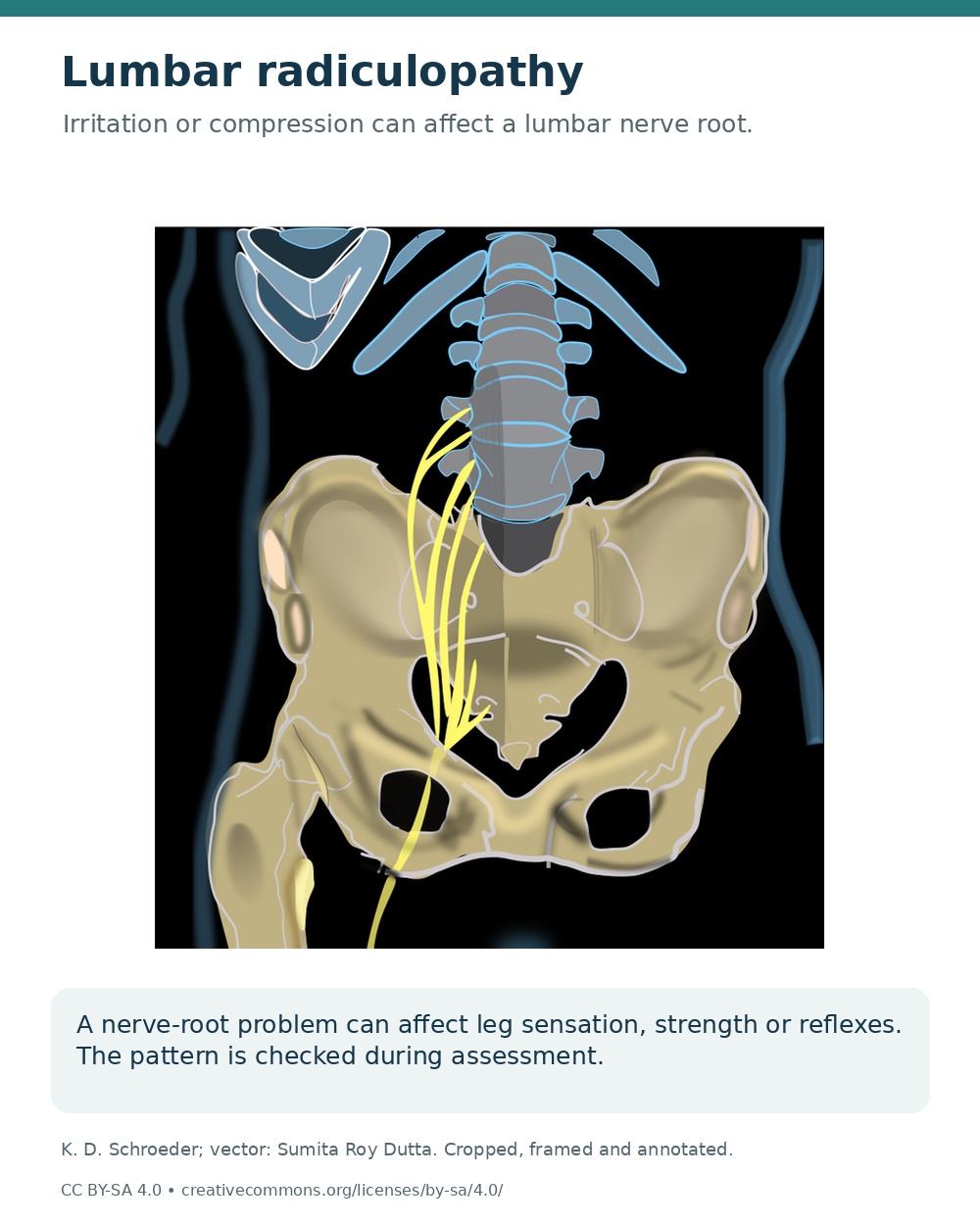
Lumbar radiculopathy refers to compression, irritation or inflammation of one or more of the nerve roots as they exit your lower spine. Symptoms arise through two overlapping mechanisms: direct mechanical pressure on the nerve root, and a local inflammatory reaction triggered by material released from the intervertebral disc. The most common cause is a herniated disc, followed by age-related narrowing of the exit canal (foraminal stenosis), spondylosis and spondylolisthesis.
Because of the anatomy of the lower spine, the great majority of disc herniations occur at the two lowest levels — approximately 95% at L4/L5 or L5/S1 — compressing the L5 or S1 nerve root and producing the familiar pattern of pain radiating below the knee. The affected root determines where you feel symptoms: the L5 root refers to the top of the foot, while the S1 root refers to the sole and outer border of the foot.
The natural history is generally favourable. Most people improve substantially over roughly 6–12 weeks with active, conservative care, and herniated disc material often shrinks naturally over time. A meta-analysis reported spontaneous resorption of lumbar disc herniation in around two-thirds of cases (Zhong et al., Pain Physician, 2017). Improvement does not always mean being completely pain-free, however, and a minority of people experience persistent or recurrent symptoms.
It is worth distinguishing lumbar radiculopathy from two related terms. Non-specific low back pain is confined largely to the back without nerve-root involvement. "Sciatica" is the everyday label for radiating leg pain in a nerve-root distribution — NICE deliberately uses the familiar word sciatica to mean lumbosacral radicular pain, although radiculopathy is the more precise term (NICE CKS, Sciatica (lumbar radiculopathy), 2025). Low back pain and its radicular forms remain the leading global cause of years lived with disability (Hartvigsen et al., The Lancet, 2018).
Do You Experience These Symptoms?
✓ You feel pain radiating from your lower back or buttock down into your thigh, leg or foot, often in a specific band or line rather than vaguely across your back
✓ You notice pins and needles, tingling or numbness in part of your leg or foot
✓ You have weakness in specific movements — such as difficulty lifting the front of your foot, pushing off your toes, or a sense that your knee gives way
✓ Your symptoms are usually worse on one side, and the leg pain feels sharp, burning or electric rather than a dull ache
✓ Coughing, sneezing, straining or prolonged sitting makes your leg symptoms worse
✓ Certain positions ease your symptoms — many people feel more comfortable walking or lying down than sitting
✓ You may notice a reduced or altered reflex in the affected leg, which we check during your assessment
These symptoms can be treated.
The sooner you begin, the better your chances of a smoother recovery.
What Causes Lumbar Radiculopathy?
• Herniated (slipped) intervertebral disc
This is by far the most common cause, accounting for around 90% of lumbosacral radicular pain.
When the soft inner part of a disc bulges or extrudes, it can press on and chemically irritate the nearby nerve root.
• Age-related degeneration and foraminal stenosis
Over time your discs lose height and bony spurs can form, narrowing the small openings through which nerve roots leave the spine.
This gradual narrowing can compress a root and is a more common cause in older adults.
• Spondylolisthesis
Here one vertebra slips forward relative to the one below it, reducing the space available for a nerve root.
The resulting compression can produce radicular symptoms in one or both legs.
• Spinal canal stenosis
Narrowing of the main spinal canal can irritate several nerve roots at once, sometimes causing symptoms in both legs.
This often causes leg pain that builds with walking or prolonged standing and eases when you sit or bend forwards.
• Less common causes
Trauma and, rarely, infection or tumour can also compress a nerve root.
These are uncommon, but they are part of why we screen carefully for warning signs during your assessment.
How We Treat Lumbar Radiculopathy at J&J Therapy
Hands-On Manual Therapy
Hands-on treatment tailored to your assessment.
Our physiotherapists use gentle lumbar mobilisation and soft-tissue techniques to ease movement and settle the muscle guarding that often accompanies nerve-root pain, alongside neural mobilisation (nerve gliding) to help restore normal nerve movement. A meta-analysis of 20 randomised trials found neural mobilisation significantly reduced pain and disability in lumbar radiculopathy (Lin et al., Life, 2023).
Always delivered as part of an active, exercise-based plan, as UK guidance recommends.
Shockwave Therapy*
For conditions involving direct nerve compression at the spine, our care emphasises specialised manual therapy and targeted exercises — the most appropriate approach for your specific needs.
Shockwave is not applied over the spine or close to large nerves, so it does not form part of your treatment plan for lumbar radiculopathy.
If your assessment identifies a separate soft-tissue problem where shockwave may help, we will discuss that with you as its own plan.
Targeted Exercise Programme
A progressive programme built around your assessment.
We look for a directional preference — a movement direction that eases and centralises your leg symptoms — and use it as the cornerstone of your self-management, alongside gentle neural glides, graded core and hip strengthening, and safe lifting and posture technique.
Exercise is recommended as a first-line treatment for low back pain and sciatica (NICE NG59). We progress your programme towards the work, sport and daily tasks that matter to you.
When to Seek Urgent Medical Help
While most symptoms are not serious, urgent medical attention is required if you experience any of the following:
Difficulty passing urine, loss of bladder or bowel control, or numbness around your saddle area, genitals or inner thighs (possible cauda equina syndrome — seek emergency care immediately)
New numbness or weakness affecting both legs at the same time
Progressive or rapidly worsening leg weakness, such as a foot drop that is getting worse rather than better
Back or leg pain with fever, unexplained weight loss, a history of cancer, or following significant trauma
FAQs About Lumbar Radiculopathy
Is lumbar radiculopathy the same as sciatica?
They overlap. "Sciatica" is the everyday term for radiating leg pain caused by irritation of a nerve root in your lower back, while "lumbar radiculopathy" is the more precise medical term for that same nerve-root problem. NICE uses the word sciatica because patients and clinicians recognise it. True radiculopathy usually involves neurological features such as numbness, tingling or weakness, not pain alone.
Will it get better without surgery?
For most people, yes. The majority improve substantially over about 6–12 weeks with active, conservative care, and herniated disc material often shrinks naturally over time — research suggests this happens in around two-thirds of cases. Surgery is generally reserved for severe or persistent symptoms that have not responded to conservative care, or for specific red-flag situations. Research suggests physiotherapy may help ease your symptoms and support your recovery in the meantime.
Should I rest or keep moving?
Staying as active as your symptoms allow is recommended — prolonged bed rest is unhelpful and can slow your recovery. Our physiotherapists will guide you on pacing your activity, which movements may ease your symptoms, and how to progress safely week by week.
Do you use shockwave therapy for lumbar radiculopathy?
No. Because this condition involves an irritated or compressed nerve root at the spine, applying shockwave over the spine or near the large nerves of the leg falls outside the manufacturer’s safety guidance for the Swiss Storz Medical MASTERPULS, and there is currently no reliable evidence that shockwave helps nerve-root pain. We focus instead on manual therapy, neural mobilisation and a targeted exercise programme, which the evidence supports. If we identify a separate soft-tissue problem where shockwave is appropriate, we would discuss that with you separately.
How many physiotherapy sessions will I need?
This varies with your individual presentation, but many people begin with an assessment followed by a course of around 4–6 sessions over 6–8 weeks, reviewed against your progress. Some people need fewer; others with more persistent symptoms may benefit from a longer plan. We agree a realistic plan with you and adjust it as you improve.
This page is for general information only and does not replace professional medical advice.
Reviewed by Lavya Arigalayan, MSc, HCPC Registered Physiotherapist.
Last reviewed:
2026년 8월 20일