top of page
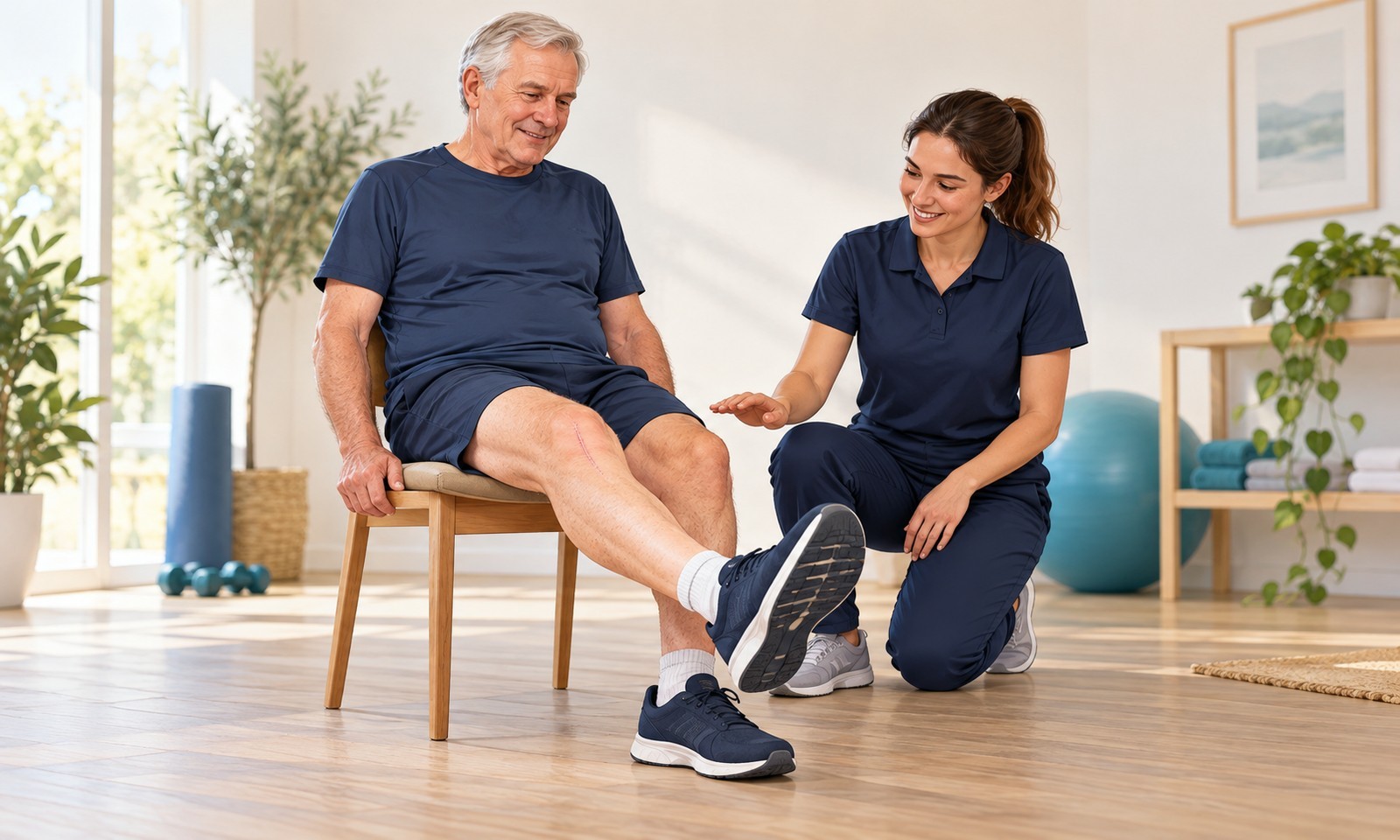
Physiotherapist guiding an older patient through knee exercises after a knee replacement at J&J Therapy in New Malden

Knee Replacement Rehab (Pre & Post)

300+ Reviews 5.0

Open 7 Days

10+ Years' Experience

HCPC Physio On Team

Insurance Accepted

85% Return Rate

PHYSIOTHERAPY & THERAPEUTIC MASSAGE IN NEW MALDEN

Quick Summary

Whether you are preparing for a knee replacement or recovering from one, our physiotherapists can help you rebuild strength, movement and confidence at every stage. We begin with a thorough assessment and then design a progressive programme — combining hands-on manual therapy with a targeted, individualised exercise plan that we review and advance as your knee heals. We work alongside your surgical team so that your rehabilitation stays safe and on track.

What Is Knee Replacement Rehabilitation?

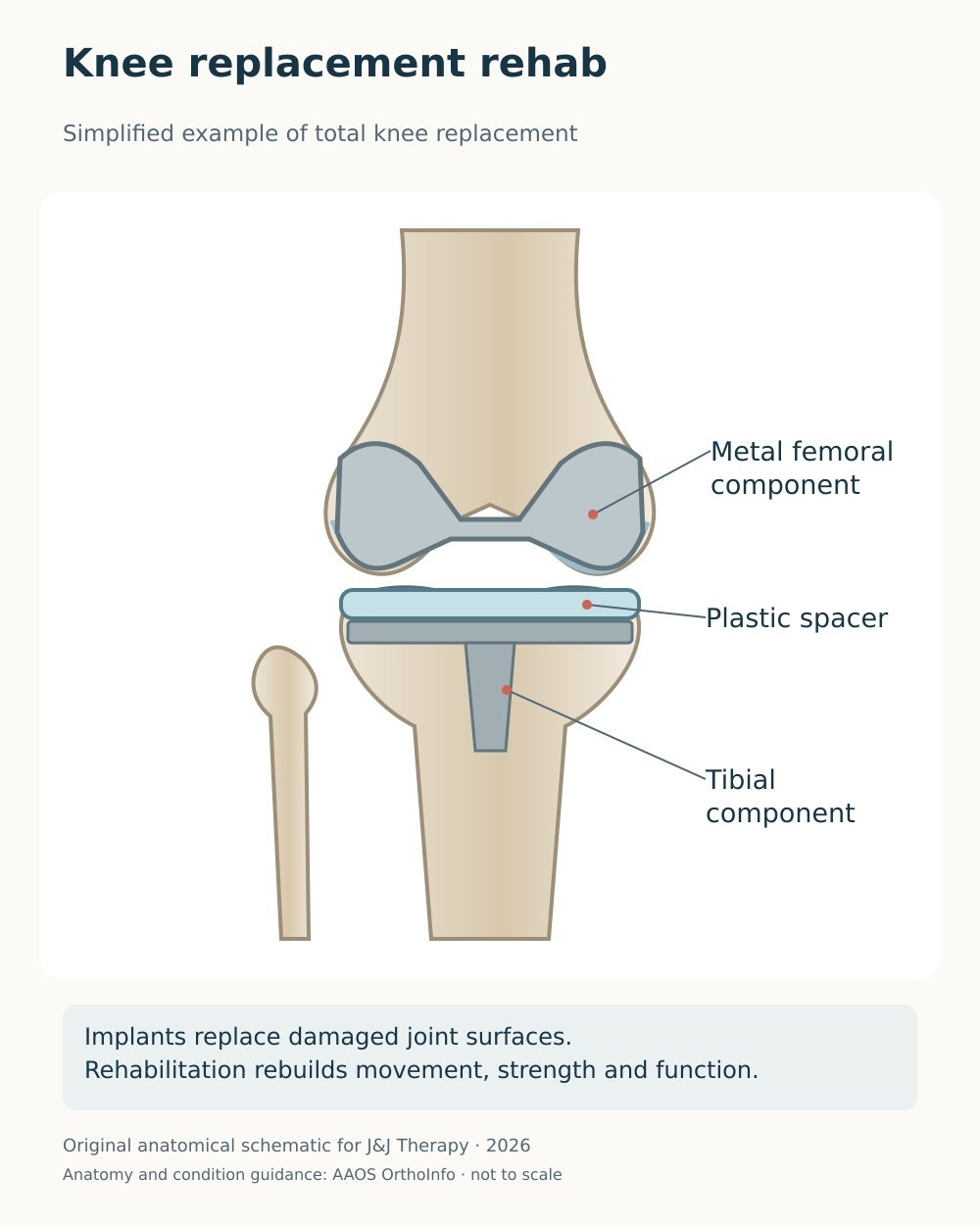
Diagram of a total knee replacement showing the metal and plastic implant on the thigh and shin bones

A total knee replacement (total knee arthroplasty) replaces the worn surfaces of your knee — the ends of the thigh bone (femur) and shin bone (tibia), and sometimes the kneecap (patella) — with metal and plastic implants. A partial, or unicompartmental, replacement resurfaces only the damaged compartment and generally has a shorter recovery.

Knee replacement is one of the most common and successful orthopaedic operations in the UK. The National Joint Registry records more than 100,000 knee replacements each year in England and Wales, and the lifetime likelihood of needing one is on average around one in six for women and one in ten for men (National Joint Registry, 2024).


Rehabilitation matters because the operation, while relieving arthritic pain, adds a fresh episode of surgical trauma to a joint and muscles that are often already deconditioned. NICE recommends that you are given advice on rehabilitation before your operation, and that a physiotherapist or occupational therapist begins rehabilitation on the day of surgery where possible and no later than 24 hours afterwards (NICE NG157, 2020).

The biggest early obstacle is quadriceps weakness. Research shows that patients may lose a substantial proportion of their knee-extension strength in the operated leg in the first days after surgery, driven largely by arthrogenic muscle inhibition — a reflex reduction in the nerve signal to the thigh muscle caused by swelling, inflammation and altered signalling from the joint. Evidence suggests strength often remains reduced at three months and may not return to pre-operative levels until around 12 months, which is why restoring quadriceps activation early is a central goal of your programme.


Recovery is usually described in phases. In the first six weeks the priorities are controlling swelling, protecting the wound, restoring a straight knee and regaining bend, and walking safely. Between six and twelve weeks the focus shifts to progressive strengthening, balance and normalising your walking pattern. From three to six months most people regain the majority of their function, and improvements can continue up to around twelve months. Common milestones are approximately 90 degrees of bend by two weeks and around 110–120 degrees by six weeks, although individual progress varies.

Evidence for structured rehabilitation is encouraging, though honest about its limits. A meta-analysis of exercise-based physiotherapy after knee replacement found short-term improvements in physical function and pain at three to four months, with longer-term differences harder to demonstrate (Artz et al., BMC Musculoskeletal Disorders, 2015). Preparation before surgery shows a similar picture: research suggests prehabilitation may improve knee function before and in the first three months after surgery and may reduce post-operative pain, with long-term effects inconclusive (Gränicher et al., JOSPT, 2022).

Do You Experience These Symptoms?

✓  Stiffness and limited movement — difficulty fully straightening or bending your knee, especially in the first weeks after surgery

✓  Thigh muscle (quadriceps) weakness, with a feeling that the leg wants to give way, or a lag when trying to lift your straightened leg

✓  Swelling and warmth around the knee that can persist for weeks or months and tends to increase with activity

✓  Difficulty with stairs, standing up from a low chair, and getting in and out of a car

✓  Tightness, numbness or sensitivity around your surgical scar

✓  Difficulty and discomfort with kneeling — one of the most commonly reported longer-term limitations

✓  Disturbed sleep from night-time pain and stiffness, particularly in the early recovery period

These symptoms can be treated.
The sooner you begin, the better your chances of a smoother recovery.

Why Can Recovery After Knee Replacement Be Difficult?

•  Post-operative swelling and effusion

Fluid inside and around the joint is an expected response to surgery, but it physically limits how far your knee can bend and straighten.

Swelling also contributes directly to shutting down the thigh muscle, so managing it is a rehabilitation priority.


•  Quadriceps arthrogenic muscle inhibition

After surgery your nervous system reflexively reduces its drive to the quadriceps, so the muscle cannot be fully activated even when you try.

This inhibition, combined with muscle wasting, explains why strength can lag for many months and why targeted activation work matters early.


•  Scar tissue and soft tissue adhesion

As the wound heals, the skin, fat pad and deeper tissues can become tethered and tight, restricting how they glide over one another.

Left unaddressed, excessive internal scarring — known as arthrofibrosis — is a recognised cause of a persistently stiff knee.


•  Deconditioning before surgery

Many people limit their activity for months or years because of arthritic pain, so they come to surgery with weaker muscles and a stiffer joint.

A poorer starting point tends to mean a longer recovery, which is the reasoning behind preparing with prehabilitation.


•  Fear of movement and pain avoidance

It is natural to protect a newly operated knee, but avoiding movement allows stiffness and weakness to set in.

Gentle, graded loading — guided so that you know what is safe — is generally more effective than rest.


Not sure which condition applies to you?

How We Support Your Knee Replacement Recovery at J&J Therapy

Hands-On Manual Therapy

Hands-on soft tissue work for the quadriceps, hamstrings and calf, gentle scar and kneecap mobilisation to restore glide, and graded joint mobilisation to ease stiffness — always within comfortable limits and coordinated with your surgical team.

Shockwave Therapy*

Swiss Storz Medical MASTERPULS
is not a routine part of knee replacement rehabilitation, and we never apply it over your implant. In selected cases it may complement your manual therapy and exercise programme for soft tissue problems away from the joint — only once your wound has fully healed and your surgeon has confirmed you are clear of blood-clot risk.
Considered solely after assessment. Non-invasive, evidence-informed, and never a first-line treatment.

Targeted Exercise Programme

Prehabilitation before surgery, then early range-of-motion work, swelling control and quadriceps activation, progressing to resistance training, balance, stair practice and gait re-education tailored to your personal goals.

When to Seek Urgent Medical Help

While most symptoms are not serious, urgent medical attention is required if you experience any of the following:

  • Increasing pain, spreading redness or warmth, or fluid leaking from the wound, with or without fever or chills (possible joint infection)

  • New calf pain, tenderness, swelling or redness in your lower leg (possible blood clot) — and call 999 if you develop sudden breathlessness or chest pain

  • Sudden inability to bear weight, the knee giving way or locking, or a loud pop with an obvious change in the shape of the joint

  • A wound that reopens or will not heal, or rapidly increasing swelling and pain that is out of keeping with your expected recovery

FAQs About Knee Replacement Rehabilitation

  • How long does recovery take?

Most people walk with aids within days and see substantial progress by six weeks, but full recovery is generally a six to twelve month process, with strength and movement continuing to improve throughout the first year. Older adults and those who were less active before surgery may take longer, which is entirely normal.


  • When can I drive or return to work?

The NHS advises waiting at least six weeks to drive after a total knee replacement, and around three weeks after a partial replacement — and only once you can safely perform an emergency stop and are off strong pain medication. Always check with your surgeon first. Desk-based work is often possible within a few weeks, while physically demanding jobs may require considerably longer.


  • Is it normal for my knee to feel warm and swollen?

Yes — some warmth and swelling is expected for weeks and sometimes months after surgery, and it often increases with activity. However, if the swelling and warmth are rapidly worsening or come with spreading redness, wound discharge or fever, seek urgent medical advice, as these can be signs of infection.


  • How much knee bend should I expect?

Many people reach around 90 degrees of bend by two weeks and 110–120 degrees by six weeks. Everyday activities such as climbing stairs and rising from a chair generally need at least around 90 degrees, so regaining flexion is an important goal. If your bend stalls in the first few months your surgeon may occasionally suggest a manipulation under anaesthetic, and physiotherapy plays a key role both in trying to avoid this and in recovering afterwards.


  • Is shockwave therapy used after a knee replacement?

Shockwave therapy is not a routine or first-line part of recovery after a knee replacement, and we never apply it over your new joint. Occasionally, once your wound has fully healed and your surgeon has confirmed you are clear of blood-clot risk, it may be considered only for soft tissue problems away from the implant — such as stubborn tendon or muscle pain — as an addition to your manual therapy and exercises. Your physiotherapist will discuss whether it is appropriate for you after assessing your knee.

Not sure this condition matches your symtoms?
Find your condition and explore related pain areas.

Logo_Navy.png

Ready to start your recovery?
Book your Initial Assessment today.

This page is for general information only and does not replace professional medical advice.

Reviewed by Lavya Arigalayan, MSc, HCPC Registered Physiotherapist.

Last reviewed

2026년 8월 20일

bottom of page