top of page
Physiotherapist in New Malden assessing a postnatal woman's abdominal muscle separation

Diastasis Recti

300+ Reviews 5.0

Open 7 Days

10+ Years' Experience

HCPC Physio On Team

Insurance Accepted

85% Return Rate

PHYSIOTHERAPY & THERAPEUTIC MASSAGE IN NEW MALDEN

Quick Summary

Diastasis recti is a widening of the gap between the two halves of your rectus abdominis muscle along the linea alba, most often after pregnancy. It can leave you with a persistent tummy bulge, a feeling of core weakness, and sometimes lower back or pelvic discomfort. The reassuring news is that it frequently improves with time and targeted rehabilitation — research suggests progressive deep abdominal and pelvic floor training may help reduce the separation and, just as importantly, restore your strength and function. Most patients attend an initial assessment followed by a structured programme, typically around 6–8 sessions over 3–4 months, with home exercises between visits.

What Is Diastasis Recti?

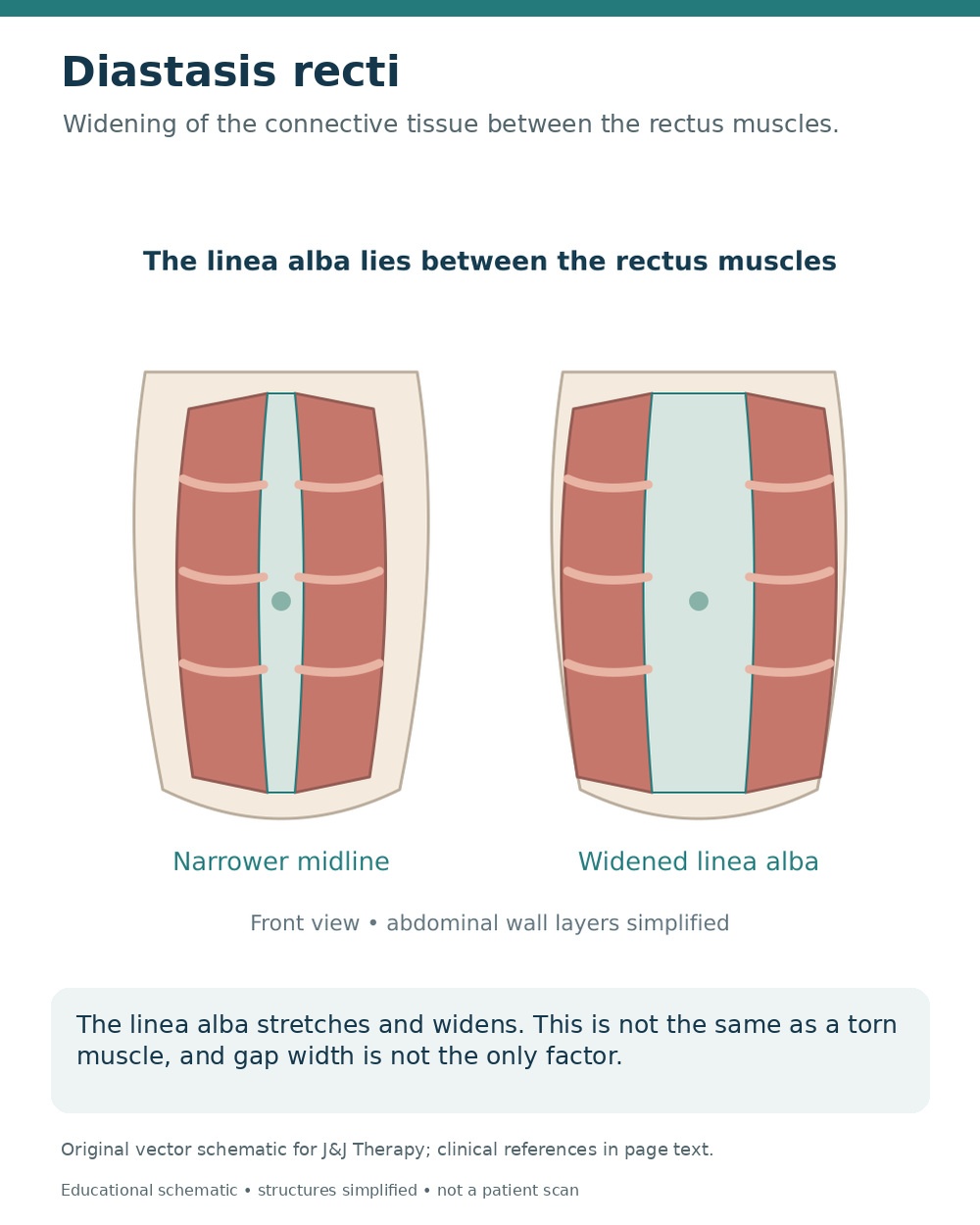
Diagram showing separation of the rectus abdominis muscles and a widened linea alba in diastasis recti

Diastasis recti abdominis, also known as rectus abdominis diastasis or divarication of the recti, is an increase in the distance between the two halves of your rectus abdominis muscle. It happens because the linea alba — the midline seam of connective tissue running from your breastbone down to your pubic bone — stretches and thins. It is a connective tissue change rather than a muscle tear: the muscles move apart as the linea alba widens and loses its ability to generate tension across the midline.


During pregnancy your abdominal wall lengthens and widens under two combined influences — hormonal softening of connective tissue, and the mechanical load of the growing uterus. This is why some degree of separation is almost universal in late pregnancy.


How separation is measured

There is no single agreed threshold, which is worth knowing before you measure yourself at home. Diastasis recti is commonly defined as an inter-recti distance greater than 2 cm, or more than two finger-widths. Palpation-based grading classifies separation as mild (2–3 finger-widths), moderate (3–4 finger-widths) and severe (more than 4 finger-widths) (Sperstad et al., British Journal of Sports Medicine, 2016). Separation may sit above your navel — the most common site — at the navel, or below it, and sometimes at more than one level.


How common is it?

Research suggests diastasis recti is very common. In a prospective study of first-time mothers, prevalence was 33.1% at 21 weeks of pregnancy, 60% at 6 weeks after birth, 45.4% at 6 months and 32.6% at 12 months (Sperstad et al., British Journal of Sports Medicine, 2016). A separate cohort found that all 84 first-time pregnant women had some separation by week 35, falling to 39% by 6 months postnatally (da Mota et al., Manual Therapy, 2015). It is predominantly a condition of pregnant and postnatal women, though it can also affect men and people who have never been pregnant.


Will it settle on its own?

Often, at least partly. NHS guidance notes that a small separation usually resolves by around 8 weeks after birth, while a larger separation may take 6 to 12 months and benefit from specialist physiotherapy input. A proportion of women are left with a persistent, symptomatic separation beyond a year — and this is the group we most commonly see at our New Malden clinic.

Do You Experience These Symptoms?

✓  A visible bulge, ridge or "doming" along the midline of your tummy, most obvious when you sit up from lying

✓  A soft gap you can feel with your fingertips above or below your belly button

✓  A feeling of core weakness, as though your midsection is not supporting you properly

✓  Lower back or pelvic girdle discomfort, particularly towards the end of the day

✓  Reduced trunk stability when lifting, carrying or pushing a pram

✓  A protruding or "outie" belly button

✓  A rounded lower tummy or bloated appearance that has not settled since giving birth

These symptoms can be treated.
The sooner you begin, the better your chances of a smoother recovery.

What Causes Diastasis Recti?

•  Pregnancy and childbirth

The growing uterus stretches your abdominal wall while pregnancy hormones soften the linea alba, allowing the muscles to separate.

This is by far the most common cause, which is why the postnatal period is when most people first notice it.


•  Multiple or closely spaced pregnancies

Repeated stretching gives the connective tissue less opportunity to recover between pregnancies.

Having had several children is a recognised risk factor for a separation that persists rather than resolving on its own.


•  Mechanical loading and abdominal pressure

Repeatedly forcing the abdominal wall outwards — through heavy lifting, chronic straining or poorly managed high-load exercise — can widen and maintain the separation.

How you manage pressure and breathing during effort often matters as much as the weight itself.


•  Age, body composition and genetics

Connective tissue quality changes with age and varies considerably between individuals, and a higher body weight increases the load carried by the abdominal wall.

These factors help explain why diastasis recti also occurs in men and in people who have never been pregnant.

Not sure which condition applies to you?

How We Treat Diastasis Recti at J&J Therapy

Hands-On Manual Therapy

Our physiotherapists begin with a thorough hands-on assessment — measuring your inter-recti distance by palpation, watching how your midline behaves under load, and screening your pelvic floor, breathing pattern and posture. Manual techniques including soft tissue work, gentle mobilisation of the ribcage and pelvis, and tactile cueing help you locate and control your deep abdominal muscles rather than forcing the gap closed. We also treat related areas such as your lower back and pelvis where these are contributing to your symptoms.

Shockwave Therapy*

For conditions affecting the abdominal wall — particularly in patients who are postnatal, pregnant, or planning a pregnancy — shockwave therapy is not a suitable option.
Our care emphasises specialised manual therapy and targeted exercises — the most appropriate approach for your specific needs.

Targeted Exercise Programme

Exercise is the primary evidence-based treatment for diastasis recti, and we build your programme in stages. We start by teaching you to find and gently engage your deep abdominal muscles alongside your pelvic floor, then progress to holding that control while adding limb movement and everyday load. Research suggests deep abdominal and pelvic floor training may help reduce the separation, although the measured change is often small — so we focus equally on restoring your strength, confidence and function (Gluppe et al., Brazilian Journal of Physical Therapy, 2021). We coach breathing and lifting strategies that manage pressure through your abdominal wall, avoid movements that cause visible doming in the early stages, and guide your return to running, gym work or sport once your control and load tolerance allow.

When to Seek Urgent Medical Help

While most symptoms are not serious, urgent medical attention is required if you experience any of the following:

  • A firm, painful or tender lump at your midline or belly button — especially if it will not push back in, feels hard, or comes with nausea or vomiting (possible hernia)

  • Severe or rapidly worsening abdominal pain that is out of proportion to your usual symptoms

  • Heavy or offensive-smelling vaginal bleeding, fever, or a new sensation of pelvic heaviness or bulging after birth

  • New numbness, or a bulge that changes colour, over your abdominal wall

FAQs About Diastasis Recti

  • Will my diastasis recti close on its own?

Often, at least partly. A small separation usually improves within about 8 weeks of giving birth, and many larger gaps continue to narrow over 6 to 12 months, particularly with targeted deep abdominal and pelvic floor exercise. Some separation may remain — but evidence shows your function and strength can improve considerably even when the gap does not fully close.


  • Do I need surgery for diastasis recti?

Most people do not. Conservative rehabilitation is the recommended first-line approach, and in the UK surgical repair of a diastasis without an associated hernia is generally not routinely funded on the NHS. Surgery is usually considered only where there is a hernia, or where significant symptoms persist after a proper trial of physiotherapy.


  • Can I exercise with diastasis recti?

Yes — the right exercise is part of the treatment, not something to avoid. In the early stages we guide you away from movements that make your tummy dome, such as unmodified sit-ups, and towards graded deep abdominal, pelvic floor and whole-body strengthening. As your control improves we progress you towards higher-load and impact activity, including a structured return to running.


  • Can men or people who have never been pregnant get diastasis recti?

Yes, although it is much less common. It can develop where there is sustained pressure on the abdominal wall — for example with significant weight gain, repeated heavy lifting with poor pressure management, or chronic straining. The assessment and rehabilitation principles we use are the same.


  • Do you use shockwave therapy for diastasis recti?

No. We do not offer shockwave therapy for this condition. There is no reliable trial evidence that it helps close the separation, and both international shockwave guidance and the manufacturer of our Swiss Storz Medical device advise against applying shock waves over the abdomen or during pregnancy. As diastasis recti mainly affects women who are postnatal or may become pregnant again, we believe assessment-led exercise rehabilitation and manual therapy are the safer and more evidence-based choice, and we will always be transparent with you about that.

Not sure this condition matches your symtoms?
Find your condition and explore related pain areas.

Logo_Navy.png

Ready to start your recovery?
Book your Initial Assessment today.

This page is for general information only and does not replace professional medical advice.

Reviewed by Lavya Arigalayan, MSc, HCPC Registered Physiotherapist.

Last reviewed

2026년 8월 20일

bottom of page