top of page
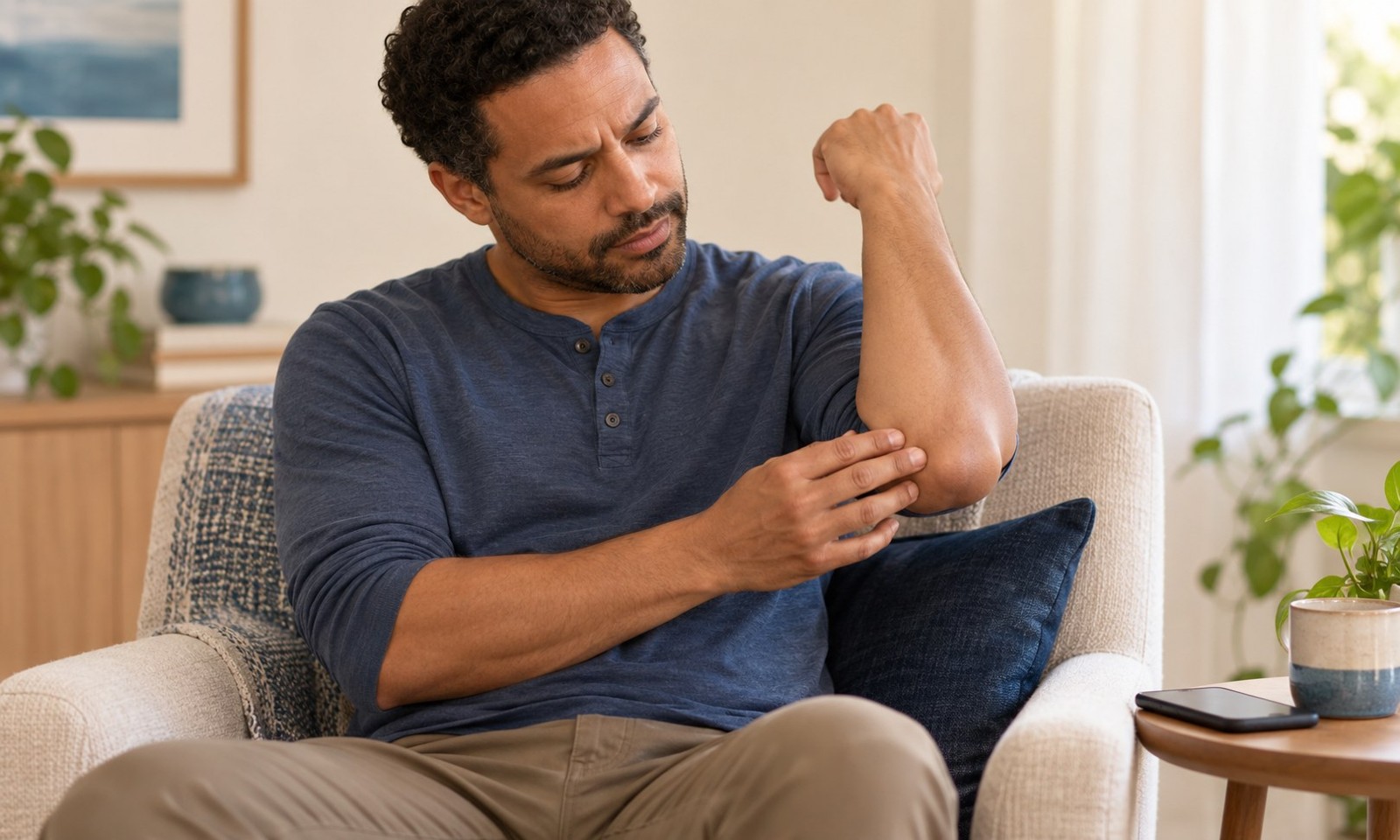
Physiotherapist assessing a patient’s inner elbow for cubital tunnel syndrome at a New Malden clinic

Cubital Tunnel Syndrome

300+ Reviews 5.0

Open 7 Days

10+ Years' Experience

HCPC Physio On Team

Insurance Accepted

85% Return Rate

PHYSIOTHERAPY & THERAPEUTIC MASSAGE IN NEW MALDEN

Quick Summary

Cubital tunnel syndrome is compression or irritation of the ulnar nerve at the inner elbow, causing tingling, numbness and sometimes weakness in your ring and little fingers — classically worse when your elbow is bent.


It is the second most common compression neuropathy of the upper limb after carpal tunnel syndrome, and research suggests most mild-to-moderate cases respond well to conservative care such as activity modification, night-time positioning and nerve gliding.


Our HCPC-registered physiotherapists provide assessment-led manual therapy and a tailored exercise programme to help settle your symptoms and protect the nerve.

What Is Cubital Tunnel Syndrome?

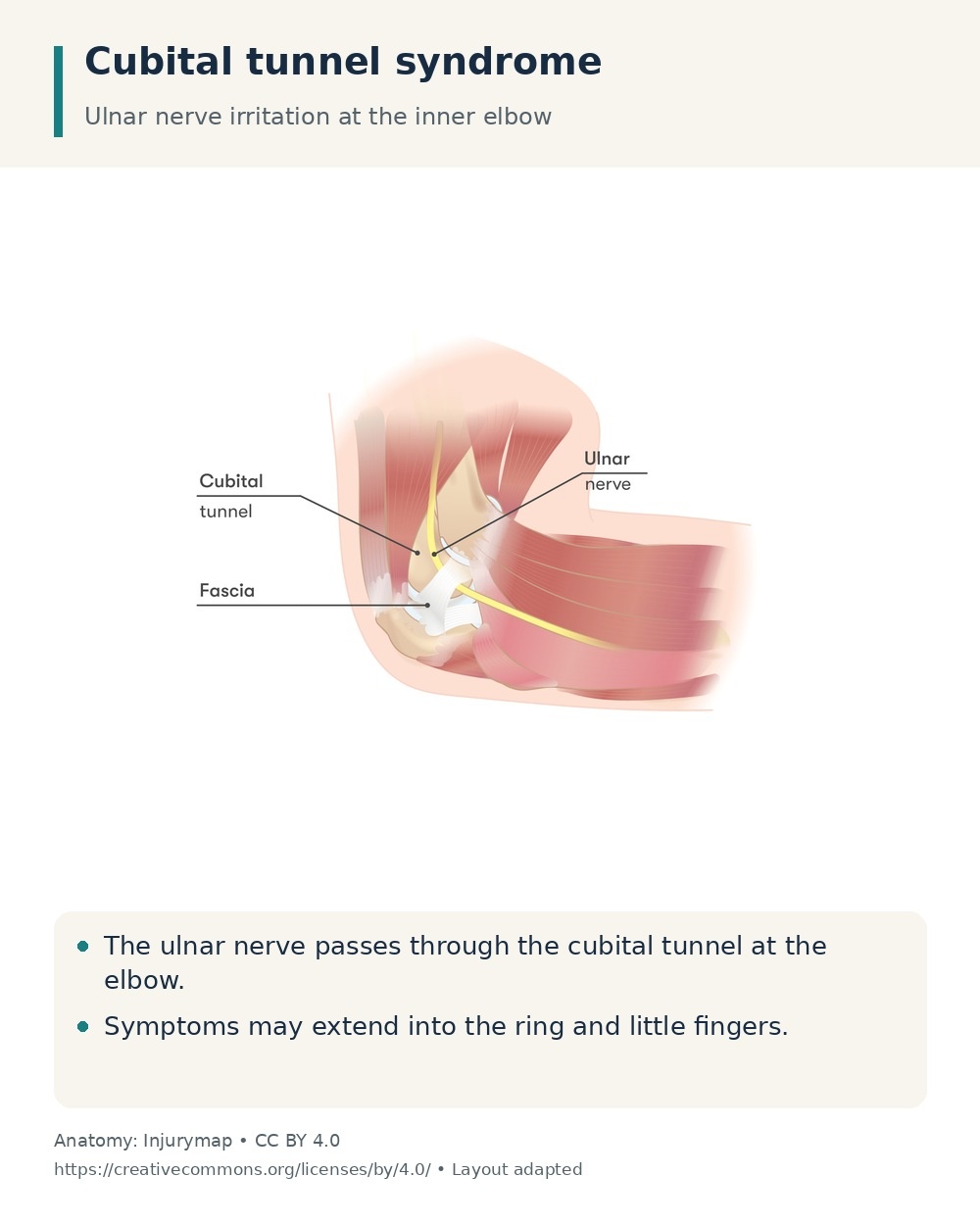
Anatomical infographic of the ulnar nerve passing through the cubital tunnel at the inner elbow

Cubital tunnel syndrome is a compressive neuropathy of the ulnar nerve as it passes behind the medial epicondyle — the bony point on the inner side of your elbow often called the "funny bone". The nerve travels through a narrow passage roofed by Osborne’s ligament and the fascia joining the two heads of the flexor carpi ulnaris muscle.


It is the second most common entrapment neuropathy of the upper limb after carpal tunnel syndrome, with an estimated population prevalence of 1.8 to 5.9 per cent.

(An et al., Journal of Bone and Joint Surgery, 2017)


The ulnar nerve is particularly vulnerable at this point because it lies close to the surface and because bending the elbow changes the shape of the tunnel. Research shows that moving the elbow from straight to fully bent reduces the volume of the cubital tunnel by around 30 to 40 per cent and substantially increases pressure within the nerve, with the lowest pressures at roughly 30 to 60 degrees of bend. This helps explain why symptoms are so often worse when you hold a phone, lean on a desk or sleep with your arm curled up.


Over time, repeated compression, traction and reduced blood supply can produce local swelling, inflammation and eventually scarring of the nerve. Clinicians commonly grade severity using the McGowan classification: mild (sensory symptoms only), moderate (sensory symptoms plus weakness) and severe (weakness with visible muscle wasting).

(McGowan, Journal of Bone and Joint Surgery British Volume, 1950)


The encouraging news is that mild and moderate cases frequently improve without surgery. Evidence shows that activity modification, night-time elbow positioning and graded nerve gliding form the foundation of effective conservative management.

Do You Experience These Symptoms?

✓  Tingling and numbness in your ring and little fingers, often the first symptom you notice

✓  Symptoms that are clearly worse when your elbow is bent — holding a phone, driving or resting your arm

✓  Night-time symptoms that wake you, or pins and needles that are present when you wake up

✓  Aching or tenderness on the inner side of your elbow, sometimes spreading into your forearm

✓  Weakness of grip or pinch, making jars, keys and buttons harder to manage

✓  Clumsiness or dropping objects, and difficulty with fine tasks such as picking up coins

✓  In long-standing cases, hollowing between the thumb and index finger, or curling (clawing) of the ring and little fingers

These symptoms can be treated.
The sooner you begin, the better your chances of a smoother recovery.

What Causes Cubital Tunnel Syndrome?

•  Prolonged elbow bending

Keeping your elbow bent for long periods — during sleep, on the phone or at a desk — sustains raised pressure inside the cubital tunnel.

This is the single most common aggravating factor and the main target of conservative treatment.


•  Direct pressure on the inner elbow

The ulnar nerve sits just beneath the skin, so leaning on a desk, car door or armrest compresses it directly.

Repeated pressure irritates the protective sheath around the nerve and reduces its blood supply.


•  Repetitive bending and straightening

Manual trades, throwing sports and repetitive assembly work load and stretch the nerve many times each day.

Over time this friction and traction can be enough to trigger symptoms even without a single obvious injury.


•  Anatomical factors and nerve instability

In some people the nerve slips forward over the bony point of the elbow as it bends, or extra soft tissue narrows the tunnel.

These structural differences can both predispose you to the problem and make it more persistent.


•  Previous injury or arthritis

Old elbow fractures or dislocations, and osteoarthritis producing bone spurs, can crowd the space available to the nerve.

Assessing your elbow history helps us understand why your symptoms have developed and how best to manage them.

Not sure which condition applies to you?

How We Treat Cubital Tunnel Syndrome at J&J Therapy

Hands-On Manual Therapy

Our physiotherapists use hands-on techniques as part of an assessment-led plan. This may include soft-tissue work to the forearm flexor muscles, gentle elbow joint mobilisation, and neurodynamic techniques designed to restore normal movement of the ulnar nerve through the tunnel. A systematic review of physiotherapy for cubital tunnel syndrome found that most studies reported clinical improvement, while concluding that no single method can yet be recommended above others (Wolny et al., Journal of Clinical Medicine, 2022). We therefore use manual therapy as one component of a broader programme, and set realistic expectations with you from the outset.

Shockwave Therapy*

Swiss Storz Medical MASTERPULS shockwave therapy is not a first-line treatment for cubital tunnel syndrome, and we would only ever consider it after a thorough assessment. A small number of early studies using low-energy radial shockwave over the ulnar nerve, alongside a larger body of research in the related carpal tunnel syndrome, suggests it may help reduce pain and improve function in some mild-to-moderate cases — but this evidence is limited and of low certainty. Activity modification, night-time elbow positioning and targeted nerve gliding remain the foundation of our care. Shockwave is not used where there is significant weakness, muscle wasting or other signs that need medical or surgical review.

Targeted Exercise Programme

The cornerstone of conservative management is activity modification combined with nerve mobilisation. We will coach you to avoid sustained deep elbow bending and direct pressure on the inner elbow, and prescribe graded ulnar nerve gliding exercises — performed gently, stopping at the point of mild symptom reproduction rather than pushing through, since aggressive stretching of an irritated nerve may worsen symptoms. As your symptoms settle we progress to grip and forearm strengthening. Evidence for individual conservative measures remains low certainty (Caliandro et al., Cochrane Database of Systematic Reviews, 2025), so we monitor your response objectively and adjust your programme accordingly.

When to Seek Urgent Medical Help

While most symptoms are not serious, urgent medical attention is required if you experience any of the following:

  • Progressive weakness or visible muscle wasting in your hand, such as hollowing between the thumb and index finger

  • Numbness in your ring and little fingers that has become constant rather than coming and going

  • Clawing or curling of the ring and little fingers that you cannot straighten

  • Rapid deterioration in your symptoms or sudden loss of hand function


These may indicate more advanced nerve compression that warrants prompt medical or hand-surgery review. Research suggests earlier intervention is generally associated with better outcomes, and we will help arrange onward referral where appropriate.

FAQs About Cubital Tunnel Syndrome

  • Can cubital tunnel syndrome improve without surgery?

Often, yes — particularly in mild to moderate cases. A prospective study of rigid night splinting combined with activity modification found that 88 per cent of treated elbows were still being managed successfully without surgery at one year (Shah et al., Journal of Hand Surgery, 2013). Cases involving marked weakness or muscle wasting are more likely to need surgical review.


  • How long does recovery take?

Many people notice improvement within a few weeks to a few months of starting conservative care, though symptoms can take up to around six months to settle because nerves recover slowly. Consistency with activity modification and your exercise programme strongly influences the outcome.


  • How should I sleep, and do I need a splint?

Try to avoid sleeping with your elbow tightly bent. A night splint or soft wrap that keeps the elbow closer to straight, at roughly 30 to 45 degrees, can reduce pressure on the nerve. A 2025 systematic review concluded the evidence is currently insufficient to determine whether night splints should be routinely recommended, so we treat this as a reasonable low-risk option that we tailor to you (Bateman et al., Hand Therapy, 2025).


  • How is this different from carpal tunnel syndrome?

Carpal tunnel syndrome affects the median nerve at the wrist, causing symptoms in the thumb, index, middle and half of the ring finger. Cubital tunnel syndrome affects the ulnar nerve at the elbow, causing symptoms in the little finger and the other half of the ring finger, and is typically worse when the elbow is bent.


  • Is shockwave therapy used for this condition?

It is not a first-line or standard treatment. Early research, together with a larger evidence base in the related carpal tunnel syndrome, suggests low-energy shockwave may help some mild-to-moderate cases, but the evidence is limited and of low certainty. If you ask, our physiotherapists will assess whether it might be a reasonable addition in your specific case and explain the uncertainties honestly.

Not sure this condition matches your symtoms?
Find your condition and explore related pain areas.

Logo_Navy.png

Ready to start your recovery?
Book your Initial Assessment today.

This page is for general information only and does not replace professional medical advice.

Reviewed by Lavya Arigalayan, MSc, HCPC Registered Physiotherapist.

Last reviewed

2026년 8월 20일

bottom of page