top of page
Physiotherapist assessing the back of a patient's knee for a Baker's cyst at a New Malden clinic

Baker's Cyst (Popliteal Cyst)

300+ Reviews 5.0

Open 7 Days

10+ Years' Experience

HCPC Physio On Team

Insurance Accepted

85% Return Rate

PHYSIOTHERAPY & THERAPEUTIC MASSAGE IN NEW MALDEN

Quick Summary

A Baker's cyst (popliteal cyst) is a fluid-filled swelling behind the knee that causes tightness, aching and a feeling of fullness. In adults it is almost always a sign of an underlying knee problem such as osteoarthritis or a meniscal tear, rather than a condition on its own.


Our physiotherapists in New Malden focus on assessing and treating the knee problem driving the swelling, combining hands-on manual therapy with a targeted exercise programme to ease your symptoms and restore comfortable movement. Most patients attend an initial assessment followed by a course of 4-6 sessions, with your programme reviewed as your knee settles.

What Is a Baker's Cyst?

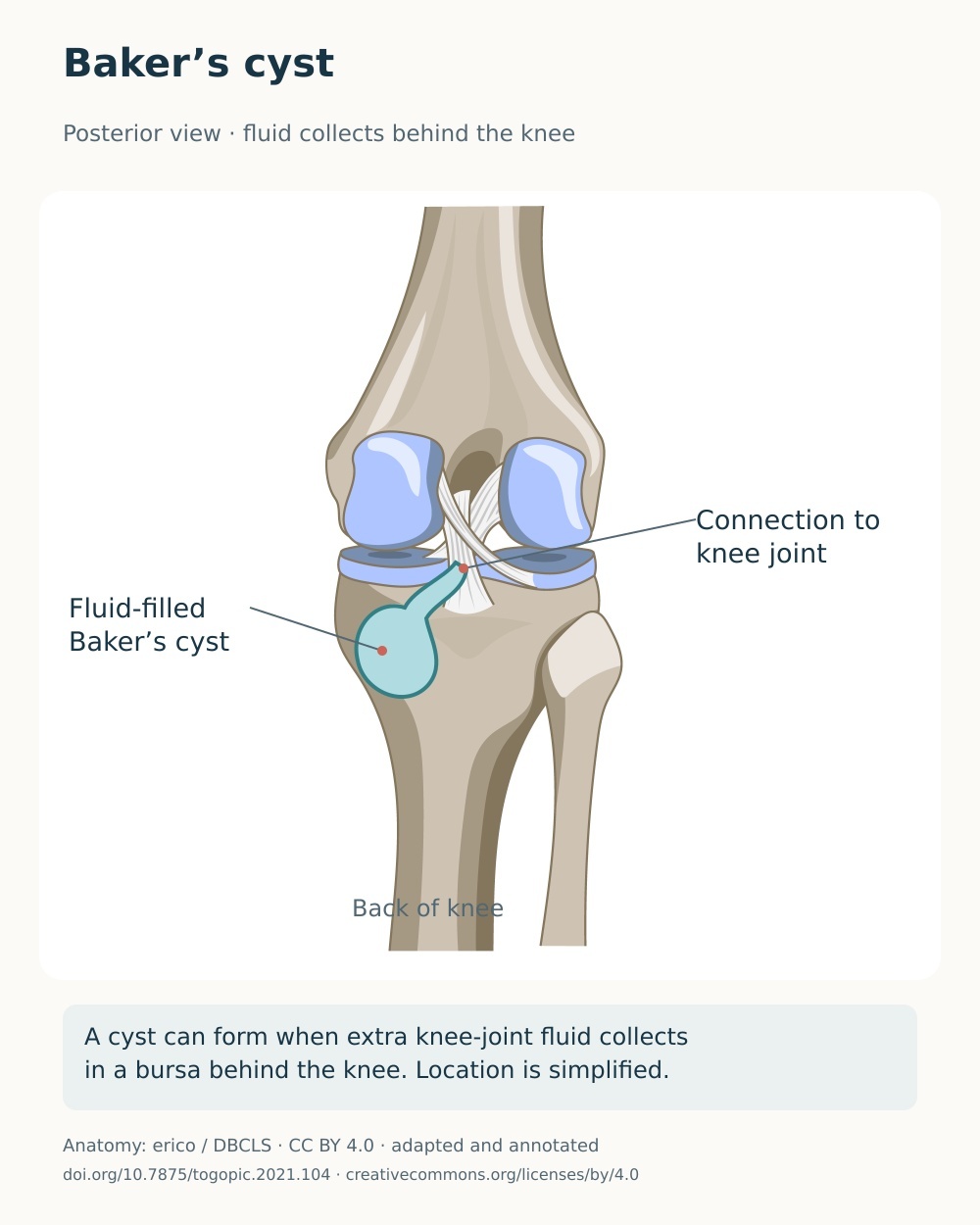
Diagram of a Baker's cyst showing fluid-filled swelling in the space behind the knee joint

A Baker's cyst is a fluid-filled swelling of the gastrocnemio-semimembranosus bursa, a small sac that sits on the inner side of the space behind your knee, between the semimembranosus tendon and the calf muscle. Unlike most bursae, this one communicates directly with the knee joint through a small slit in the back of the joint capsule.


That connection behaves rather like a one-way valve. When your knee is loaded and straightened, joint fluid is pushed out into the bursa but cannot easily flow back, so the sac gradually enlarges into a palpable cyst behind the knee.


Primary and secondary cysts

Primary cysts occur mainly in children, usually without any problem inside the joint, and commonly settle on their own. Secondary cysts occur in adults and develop because something inside the knee is producing extra joint fluid, most often osteoarthritis, a degenerative or traumatic meniscal tear, rheumatoid arthritis, gout or a persistent effusion. Research shows that more than 90 per cent of adult Baker's cysts are associated with a problem inside the knee joint (StatPearls, NCBI, 2023).


This is why the cyst is best understood as a pressure gauge for your knee. Evidence suggests that treatment should be directed at the underlying joint problem rather than the swelling in isolation, because a cyst treated on its own tends to return (Herman and Marzo, Orthopedics, 2014).


How common is it?

Baker's cysts are common and become more frequent with age. A 2022 meta-analysis reported that they affect roughly 11.7 per cent of the middle-aged and older population (Zhang et al., Journal of Orthopaedic Surgery and Research, 2022), while an ultrasound study of 399 patients attending with knee pain found a cyst in 25.8 per cent, closely related to signs of osteoarthritis and joint effusion (Filippou et al., Reumatismo, 2013).

Do You Experience These Symptoms?

✓  A soft, sometimes visible swelling at the back of your knee, usually towards the inner side and most obvious when you stand with your leg straight

✓  Tightness or a feeling of fullness behind the knee, often described as pressure or something being in the way

✓  Aching pain behind the knee, sometimes spreading into the upper calf, and typically worse with activity or prolonged standing

✓  Difficulty bending the knee fully, because a larger cyst can physically limit movement

✓  General knee stiffness, usually alongside the symptoms of the underlying problem such as osteoarthritis

✓  Symptoms that come and go, with the swelling enlarging when your knee is irritated and shrinking when it settles

✓  Occasionally, if the cyst ruptures, sudden calf pain, swelling, warmth and bruising that can closely resemble a blood clot

These symptoms can be treated.
The sooner you begin, the better your chances of a smoother recovery.

What Causes a Baker's Cyst?

•  Knee osteoarthritis

Osteoarthritis is the most common cause of a Baker's cyst in adults, because the worn joint produces excess fluid that is forced back into the bursa.

Since the cyst is a consequence of the arthritic knee, managing the osteoarthritis itself is central to reducing both the swelling and your symptoms.


•  Meniscal tears

Degenerative and traumatic tears, particularly of the back portion of the inner meniscus, are strongly linked with cysts behind the knee.

The tear irritates the joint and increases fluid production, which then feeds the one-way valve mechanism that fills the bursa (Stone et al., American Journal of Sports Medicine, 1996).


•  Inflammatory arthritis such as rheumatoid arthritis or gout

Inflammatory joint conditions inflame the joint lining and generate large volumes of fluid, which readily distends the bursa behind the knee.

Cysts are common in rheumatoid arthritis and can occasionally become large, so controlling the underlying inflammatory condition is essential.


•  Cartilage damage, ligament injury or persistent swelling

Any process that repeatedly irritates the knee, including cartilage lesions, cruciate ligament injuries or a long-standing effusion, can produce a secondary cyst.

Identifying and treating that source of irritation is what gives lasting relief rather than temporary reduction of the swelling.


•  Childhood (primary) cysts

In children the cyst usually arises without any problem inside the joint and is not related to wear or injury.

These primary cysts commonly resolve without any intervention, so reassurance and monitoring are often all that is needed.

Not sure which condition applies to you?

How We Treat Baker's Cyst at J&J Therapy

Hands-On Manual Therapy

Our first priority is a careful assessment to confirm the diagnosis, screen for the more serious conditions that can mimic a Baker's cyst, and identify the knee problem driving the swelling. Because your symptoms usually originate from the joint rather than the cyst itself, our physiotherapists use hands-on manual therapy, including soft-tissue techniques and graded joint mobilisation around the knee and surrounding muscles, to ease pain, reduce stiffness and improve your range of movement. We do not apply forceful pressure directly to the cyst. Treatment is combined with education, activity modification and simple measures such as relative rest, ice and elevation. Where imaging or specialist input is needed, we refer you appropriately, in line with NICE guidance that ultrasound is the first-line investigation and that direct aspiration of a Baker's cyst is not carried out in primary care.

Shockwave Therapy*

Shockwave therapy is not applied to a Baker's cyst itself or to the back of the knee. The space behind the knee contains major blood vessels and nerves, and both international shockwave guidance and Storz Medical device documentation advise against directing shockwaves near large vessels and nerves or over a possible blood clot. There is also no clinical trial evidence that shockwave treats a Baker's cyst. Because the cyst reflects an underlying knee problem, our physiotherapists may in selected cases consider shockwave therapy for that underlying degenerative knee condition, applied well away from the back of the knee, where research suggests it may help pain and function in knee osteoarthritis. We would only do so after a thorough assessment has excluded serious causes such as a blood clot, an arterial aneurysm or a tumour, and it is always combined with manual therapy and exercise rather than used on its own.

Targeted Exercise Programme

The mainstay of physiotherapy for a Baker's cyst is a progressive exercise programme aimed at the knee that is driving the swelling. Our physiotherapists design an individualised plan that typically includes gentle range-of-movement work such as heel slides, quadriceps and gluteal strengthening including straight-leg raises, bridging and, as symptoms allow, wall squats, together with graded hamstring and calf flexibility work performed within a comfortable range. Strengthening the muscles that support and offload the knee, improving movement control and addressing contributing factors such as activity load and body weight can reduce your symptoms and help manage the underlying osteoarthritis or meniscal problem. Where symptoms persist, ultrasound-guided aspiration with a corticosteroid injection reduces cyst size in around two-thirds of patients but recurs in roughly one in five within six months, and surgery is reserved for stubborn cases, so we will explain honestly where physiotherapy fits and liaise with your GP or a specialist when needed.

When to Seek Urgent Medical Help

While most symptoms are not serious, urgent medical attention is required if you experience any of the following:

  • Sudden calf pain, swelling, redness or warmth, with or without the lump behind your knee becoming smaller, which may indicate a ruptured cyst or a blood clot. If you also develop breathlessness or chest pain, call 999.

  • A pulsating or throbbing lump behind the knee, which needs urgent vascular assessment as it may indicate an arterial aneurysm.

  • A rapidly enlarging, hard or fixed lump, night pain or unexplained weight loss, as not every swelling behind the knee is a Baker's cyst.

  • Numbness, pins and needles, weakness or a foot that drops, which suggest nerve compression and need prompt medical attention.

FAQs About Baker's Cyst

  • Will my Baker's cyst go away on its own?

Often, yes. Many cysts settle over time, particularly once the underlying knee problem is managed, although this can take anywhere from a few months to a few years. Cysts in children commonly resolve without any treatment at all.


  • Should the cyst be drained?

Draining, known as aspiration, can reduce a large or uncomfortable cyst and is sometimes combined with a corticosteroid injection. However, the cyst frequently returns because the knee continues to produce fluid, with recurrence in around one in five patients within six months. NICE advises against direct aspiration in primary care, so we treat the underlying knee problem first and refer for ultrasound-guided aspiration or a specialist opinion when appropriate.


  • Can I exercise with a Baker's cyst?

Usually yes, with the right guidance. Gentle range-of-movement, strengthening and flexibility exercises can ease your symptoms and support the knee, provided they do not increase pressure behind the joint. Our physiotherapists will tailor a programme to your specific knee condition and current symptom level.


  • Do you use shockwave therapy on a Baker's cyst?

No. We do not apply shockwave to the cyst or to the back of the knee, because that area contains major blood vessels and nerves and there is no trial evidence that shockwave treats a Baker's cyst. In selected cases, and only after a full assessment has excluded serious causes, we may consider shockwave for the underlying degenerative knee condition, applied away from the back of the knee, where research suggests it may help osteoarthritis pain and function.


  • How do I know it is not something more serious?

That is exactly why assessment matters. A Baker's cyst can resemble a blood clot, and rarely an arterial aneurysm or a tumour can look similar. Our physiotherapists screen for these, use a simple clinical test in which the swelling becomes firmer as the knee straightens, and refer you for ultrasound or specialist review if anything is unclear.

Not sure this condition matches your symtoms?
Find your condition and explore related pain areas.

Logo_Navy.png

Ready to start your recovery?
Book your Initial Assessment today.

This page is for general information only and does not replace professional medical advice.

Reviewed by Lavya Arigalayan, MSc, HCPC Registered Physiotherapist.

Last reviewed

2026년 8월 20일

bottom of page